
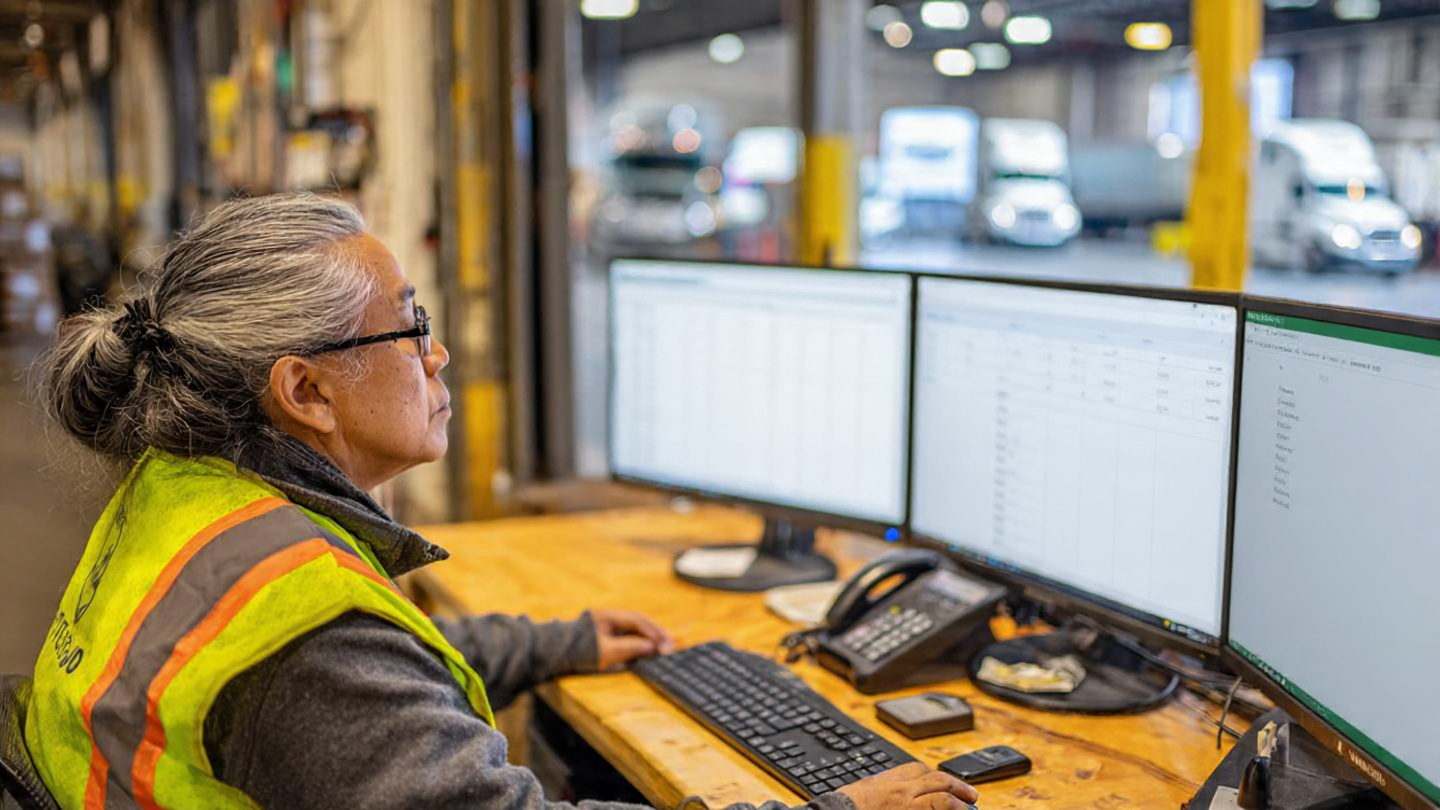
Your logistics coordinator is not a call center agent. But between incoming calls from carriers asking if their dock is ready, outbound calls to confirm arrivals, WhatsApp follow-up messages, and the back-and-forth between guard, coordinator, and yard — they hit 50 interactions before noon. In an eight-hour shift, that is more than three hours gone.
The problem is not the carriers. They have no information. They don't know if their appointment is still on, whether the dock will be open when they arrive, or if they're running early or late against their window. The call is their only way to reduce that uncertainty. And until that changes, the phone is going to keep ringing.
This article does not propose asking carriers to stop calling. It proposes giving them the information so they do not have to.
McKinsey estimates that between 60% and 70% of manual coordination tasks in logistics can be automated with tools already available, without complex integrations (McKinsey, 2023). Dock appointment coordination is exactly that kind of task: repetitive, predictable, and unnecessary as a manual workflow.
Every truck arriving at your facility generates its own communication loop before it touches a dock. Without a system that breaks that loop, it repeats with every unit.
Here is how it runs:
That is three to four calls per truck, before arrival. For a 45-truck-per-day operation, you are looking at more than 150 confirmation interactions before noon. And that assumes nothing goes wrong.
If the dock is not ready when the truck arrives, the loop restarts: the carrier calls from the gate, the coordinator talks to the yard again, and the guard cannot give instructions without confirmation. Another loop. Another 15 to 20 minutes of active waiting.
The direct cost of 50 daily calls is already captured in the base cost model from this series. Just the coordinator line item:
200 minutes per day × $65 MXN per hour = $216 MXN per day → approximately $4,800 MXN per month.
That is what you pay in coordination time to maintain a process a scheduling system would resolve before the shift begins.
But the direct cost is not the only problem. Those calls hide something worse: no audit trail.
Every verbal instruction is an agreement that exists nowhere in any system. There is no record of when the carrier confirmed, what was agreed, or who authorized entry. If a carrier disputes how long they waited, your only evidence is the memory of the people involved.
Coordinators learn to live with that condition. The problem surfaces when:
In those moments, the absence of a record is not just an operational inconvenience. It becomes a liability.
ROI check: If you have a rough estimate of how many calls your operation generates per day, run them through the Docklyx ROI calculator and compare the monthly cost of manual coordination against the cost of the software. The gap is usually larger than expected once you group it into a single number.
When a warehouse introduces an appointment system and carriers still keep calling, the problem is almost always in the same place: the system exists, but it doesn't close the information loop that was causing the calls.
Carriers call because they have no information and have learned that not having it costs them. They have seen enough "wait at the gate" moments to not trust a confirmation without backup. They don't know if they arrived on time or late against their window. And if something changes on the warehouse side after they booked, nobody tells them.
The solution is not just technology. It is technology that closes the information loop in both directions: the carrier can see their appointment status, receive automatic updates, and arrive with real context. When that happens, the confirmation call disappears because it no longer serves any function.
The flow is simple. So simple that the most common reaction from warehouse operators is "that's it?" Yes. That is it.
Step 2 is what changes everything: the slot locks at booking. That eliminates the double-booking conflicts that plague manual systems and shared spreadsheets. If you want to understand why Excel and WhatsApp don't scale for this kind of coordination, truck appointment scheduling vs Excel and WhatsApp covers exactly that.
This is the most common objection. And it usually comes from an incorrect assumption: that implementing a self-scheduling portal requires carriers to install something, learn something, or change a fundamental habit.
It doesn't.
It's not an app. It's a link that opens on the same phone they already use to call you. No download, no app store account. The QR arrives via the same WhatsApp they already use — they don't have to migrate anywhere. Access works by phone number or a single-use link. No passwords.
The incentive does the work on its own. Carriers who arrive with a QR go straight in. Carriers without an appointment wait. That doesn't require a change management campaign. Adoption is complete in under a week because the benefit is immediate and personal.
A warehouse doesn't adopt a self-scheduling portal to make carriers happy. It adopts it because it benefits the warehouse. But the secondary result is that carriers who work with that facility end up preferring it over yards still running on calls and paper.
Here is how the transition looks at a real facility.
A distribution center in Guadalajara handling 45 trucks per day, with a coordinator spending more than three hours on the phone, deployed the portal on a Monday morning. The guard learned the QR check-in flow in 15 minutes. The 10 most frequent carriers received the portal link via WhatsApp that same day with a simple note: "From now on, carriers with a QR appointment go straight in. Everyone else waits in line."
Tuesday: 6 of 10 regular carriers arrived with QR codes. Zero confirmation calls from those six. The coordinator handled exceptions only for carriers who showed up without an appointment.
Friday: 9 of 10 with QR. The one without was a new carrier who hadn't received the link yet.
Second week: full adoption. Confirmation calls stopped. The only phone interactions that remained were genuine exceptions — last-minute rescheduling, a road incident, one time window adjustment.
The coordinator recovered more than two hours of productive work per day. Not free time. Work that was previously impossible to do because the phone kept interrupting it.
The money is the easiest part to see. What changes more is operational capacity.
| Metric | Before the portal | With self-scheduling |
|---|---|---|
| Confirmation calls per day | 50+ | 0–5 (exceptions only) |
| Coordinator time on phone | 200+ min/day | <20 min/day |
| Monthly coordination cost | ~$4,800 MXN | Near zero |
| Confirmation records | None | Timestamp per appointment |
| Evidence in disputes | Memory vs. memory | Full log with time and user |
| Gate check-in time per truck | 3–8 minutes | Under 1 minute with QR |
With those hours back, the coordinator can track on-time window performance, identify carriers with chronic late arrivals, anticipate traffic peaks, and work on real exceptions instead of confirming what should already be confirmed.
To understand what happens in the yard when that coordination visibility is missing, read the piece on the hidden cost of blocked docks at your warehouse, where we break down how the base model generates between $48,000 and $62,000 MXN per month in losses that never show up on any invoice. Manual call coordination is exactly Layer 3 of that cost model.
And if you want to understand why the root problem isn't just the calls but the first-come, first-served system underneath them, first-come, first-served and why it destroys your operation closes the loop on why gate chaos keeps repeating even when the coordinator works without stopping.
A consumer goods operator in Central Mexico, running 8 docks with 40 to 50 trucks per day, had a logistics coordinator whose shift started before the gate opened. Carrier calls asking about appointment status were coming in from 6:00 a.m.
When they mapped the interaction volume, they counted 48 inbound calls in a 10-hour shift, plus 22 WhatsApp messages requiring direct responses. The coordinator kept a notebook with the day's confirmations. When someone asked "what time did you confirm that Carrier X had a dock?", the answer was checking the notebook or using memory.
After implementing the portal, the first complete operating day closed with 4 inbound calls. All four were genuine cases: one carrier with a road accident, one rescheduling request, and two new carriers who hadn't received the link yet. The other 44 calls never happened because the information that would have triggered them was already visible before anyone needed to ask.
The most important change wasn't the time recovered. It was that the coordinator was able, for the first time, to send a window compliance report at shift close with real data. Not estimates. Not memory. Actual numbers.
Docklyx's carrier self-scheduling portal was built specifically for the operating conditions of a Mexican distribution center: carriers using WhatsApp, guards with tablets at the gate, and coordinators managing real-time exceptions.
Setup takes less than one shift. No external system integrations, no hardware. In under four hours you have docks configured, availability windows defined, and the portal link ready to send.
The carrier doesn't need an account. They access via link, book their slot, receive the QR, and arrive. No registration, no password.
The guard validates with QR on screen. No calls needed. The system shows on their tablet what truck is arriving, which dock it's assigned to, and whether the time window is active.
Every appointment, arrival, and dock assignment is logged with a timestamp. In a dispute, there is evidence. In an audit, there is data.
Alerts work in both directions. If the carrier is running late, they update their appointment from the same link. If the warehouse needs to close a time window, the carrier gets an automatic notification.
The result is an operation where coordination calls stop being a routine task and become what they were always supposed to be: the exception, not the norm.
If your coordinator is spending more than three hours on the phone each shift, the cost of not changing already exceeds any adoption cost.
Docklyx includes the self-scheduling portal, QR check-in, yard visibility, and full audit trail in the base plan. No annual contracts, no additional hardware, no implementation consultants.
Start your 21-day free trial and measure the difference with real data from your own facility. Not estimates. Your own numbers.
Or calculate your current manual coordination cost first with the Docklyx ROI calculator. The number on screen is usually the most convincing argument for getting the change approved.
Docklyx digitizes the entire yard: appointments, check-in, docks, and real-time traceability.
Request free demo →One email per week. No spam.
Every blocked dock can cost your warehouse $48,000 to $62,000 MXN per month in labor, delays, and lost capacity. Calculate your real loss.
Implement dock appointment scheduling at your warehouse. Step-by-step guide covering time windows, policies, check-in, and measurement.
Nearshoring is flooding Mexican docks with volume. Learn how to prepare your distribution center for the new operational reality.