Loading docks are the connective tissue of any logistics operation. They are the exact point where inventory in transit becomes inventory in the warehouse (or vice-versa). However, in most Distribution Centers (DCs) in 2026, dock management remains the "black hole" of operational visibility. Bays are assigned reactively, valuable minutes are lost between maneuvers, and supervisors rely on radio shouts to know if a dock is free.
According to a Gartner (2025) study, inefficient dock management can reduce a DC's theoretical capacity by up to 30%, generating hidden costs that directly impact the net margin. In a market driven by nearshoring, where every square foot of warehouse space is gold, having idle or poorly used docks is waste most companies cannot afford.
This comprehensive guide details how to transform your dock management from a reactive process to a proactive, digitized one, using industry best practices and cutting-edge technology.
A poorly managed dock is more than an empty bay. It interrupts the rest of the supply chain. The impact of poor coordination at the docks has a ripple effect:
The real capacity of your operation is not determined by the physical number of docks you have, but by your effective utilization rate. A DC with 15 well-managed docks can process more volume than one with 25 operating blindly.
Through our experience optimizing logistics yards, we have identified the most common errors that hinder productivity:
Without an appointment system, all suppliers tend to arrive at 8:00 AM or just after lunch. This saturates the security gate and leaves docks empty during half the shift, while during peak hours, the queue spills onto the road.
A truck finished unloading 20 minutes ago, but the warehouse supervisor hasn't notified the traffic office, and the carrier is still connected to the dock. Those 20 minutes of "ghost dock" time are lost capacity that can never be recovered.
Sending a refrigerated truck to a dock without a pneumatic seal, or directing a 53-foot trailer to a bay with limited maneuvering space. These errors force units to be repositioned, wasting 15 to 30 minutes per event.
Treating a carrier bringing critical raw materials for the production line the same as one bringing office supplies. Without clear business rules, assignment is left to the guard's discretion, creating strategic bottlenecks.
Depending on radios to confirm status generates interpretation errors, communication noise, and a lack of historical records for audits. In 2026, voice must be replaced by data.
To achieve operational excellence, the dock management flow must be integrated into a Yard Management System (YMS). This is what a world-class process looks like:
The system analyzes the day's appointments and pre-assigns dock groups based on load type (inbound vs. outbound) and order priority.
The carrier arrives at the security gate with their QR code. The system instantly validates if the assigned dock is free. If it is, the driver receives the dock instruction immediately; if not, they are directed to a staging area with a digital queue number.
Warehouse staff receive an alert on their mobile terminal when the truck positions at the dock. Unloading begins immediately. Any incidents (damage, incomplete documentation) are recorded digitally, notifying the relevant areas in real-time.
Upon completing the maneuver, the warehouse releases the dock from their device. The driver receives an automated WhatsApp indicating they can depart, and simultaneously, the next truck in line receives instructions to proceed to the newly vacated bay.
You cannot optimize what you do not measure precisely. High-performance DCs monitor these indicators daily:
Dock Dwell Time: Exact time from when the unit docks until it departs. 2026 target: < 50 minutes for general cargo.
Dock Utilization: Percentage of operational time that the dock was actually processing cargo. Target: > 85%.
Transition Time: Minutes elapsed between one truck leaving and the next entering. Target: < 8 minutes.
Dock Appointment Compliance: Percentage of units that finish within the estimated time.
Impact Fact: According to McKinsey & Company (2025), reducing transition time between trucks by just 10 minutes can increase a DC's dispatch capacity by 12% annually without investment in physical infrastructure.
Company: Tier 1 Supplier in a major industrial cluster.
Challenge: The plant had 12 receiving docks. With the production increase from nearshoring, the docks were saturated 24/7. They had an average of 15 trucks waiting on the street, generating municipal fines and security risks. Carrier wait times exceeded 4 hours.
Solution: They implemented the Docklyx dock management module. They established automatic assignment rules based on part number and urgency for the assembly line.
120-Day Results:
The power of Docklyx lies in giving visibility to the invisible. Here is how our dock management tool works:
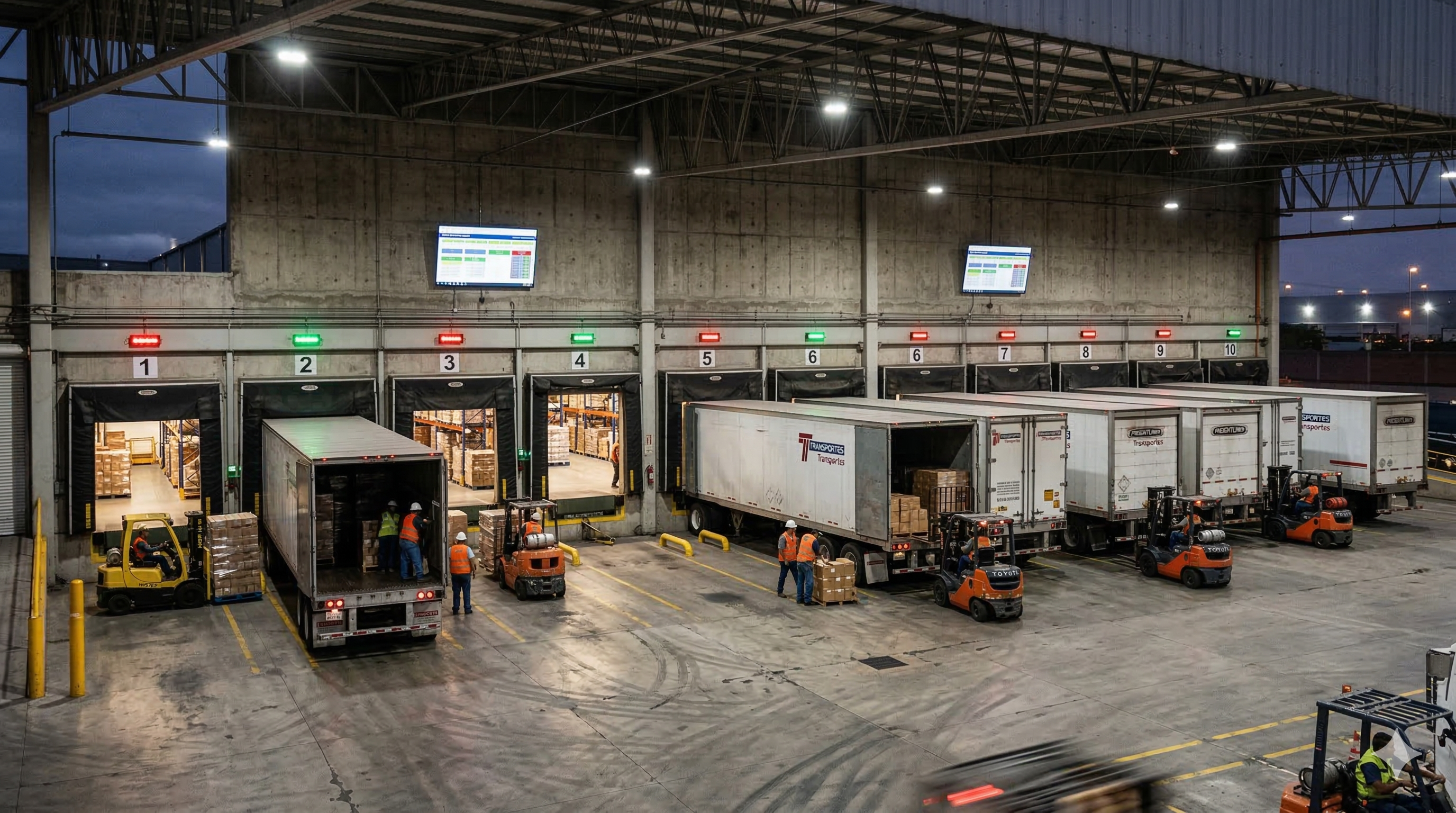
Your supervisors have a screen (or tablet) where they see each dock represented visually. Colors indicate status:
When a truck arrives at the security gate, Docklyx suggests the optimal dock. It does not only look for a free dock. It looks for the dock closest to where that merchandise will be stored, which cuts forklift travel time.
Forget about looking for the driver in the yard. When a dock is released, the system sends a message to the next carrier in line: "Unit 402, Dock 7 is ready for you. Please proceed to the maneuver." The driver confirms receipt with a click.
If a dock has been occupied for more than 60 minutes without reporting progress, the system sends a red alert to the warehouse manager. "Potential delay at Dock 3: Time exceeded by 15 minutes." This allows resolving issues (such as a broken pallet or staff shortage) before they affect the entire queue.
In practice, you receive an automated report: Which was the most productive dock? Which carriers met their times? How much money did you save today in demurrage fines?
In 2026, dock management has moved from an administrative task to a financial engineering discipline. Every minute a dock sits idle unnecessarily is a direct loss of profitability.
Digitizing your docks with Docklyx doesn't just give you control; it gives you the capacity to scale your operation without needing to build more docks. In the era of nearshoring, speed is the new currency.
Are your docks working for you or against you?
Modernize your dock management today. Schedule a Docklyx demo here.
Docklyx digitizes the entire yard: appointments, check-in, docks, and real-time traceability.
Request free demo →One email per week. No spam.