
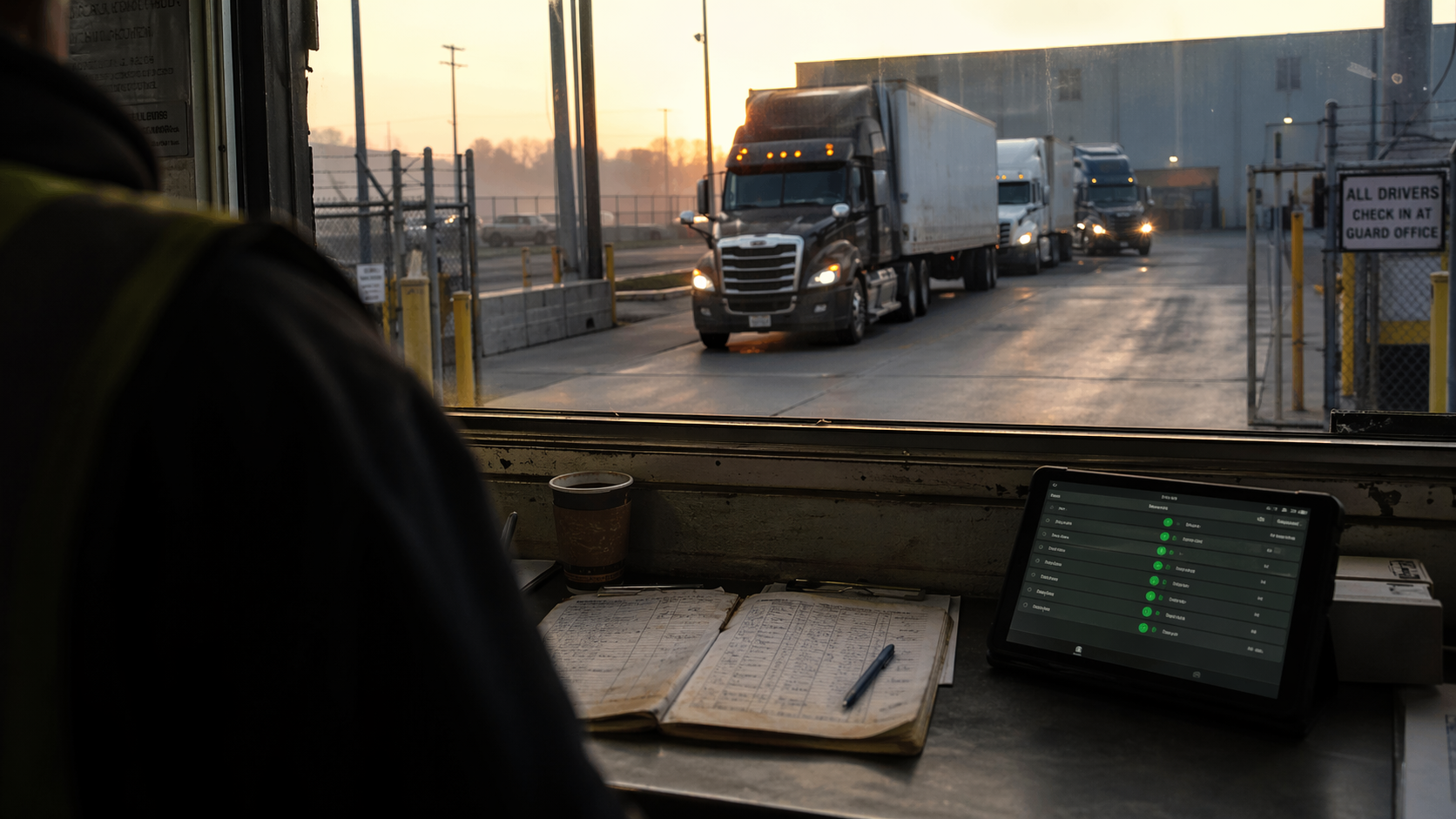
It is 5:45 in the morning. Raúl arrives at the guard booth with a coffee and a clipboard. His shift starts at six, but the first trucks have been lined up since five thirty. Three tractors idle at the gate. The drivers did not sleep well. Neither did Raúl.
What happens in the next eight hours determines whether your operation starts on time or drags through the day. And almost nobody — not the operations manager, not the logistics director — knows exactly what Raúl does during that shift.
What follows is about the eight hours of a gate guard, what those hours cost your operation when they depend on paper, and what changes when they stop depending on it.
The guard booth looks like a simple post: someone opens and closes a gate. But at a distribution center receiving 40 to 80 trucks per day, the guard is the first filter in the entire chain.
Every arriving truck requires validation. The driver steps out of the cab, walks to the window, and hands over documents. The guard must verify:
With a paper logbook, this process takes 5 to 10 minutes per truck. The guard writes the name, time, plates, and purpose of the visit by hand. If there is an appointment, they call the coordinator by radio or phone to confirm. If there is no appointment, the process gets complicated: someone must decide whether the truck enters, waits, or gets turned away — and that decision falls on a guard who has no visibility into how many docks are available.
At 60 trucks per day, those 5 to 10 minutes per check-in add up to 4 to 8 hours of gate staff time per shift just on entry registration. More than half of a guard's shift goes to writing data in a notebook.
Once a truck enters, the guard should direct it to a specific spot. In practice, most DCs running manual processes have no assignment system: the driver enters and looks for an open space. This creates unnecessary movements, double-parked trucks, and a yard that nobody can read from the gate.
The guard loses visibility of the yard the moment the truck crosses the barrier.
When a truck finishes at the dock and heads to the exit, it needs to pass through the gate to register departure. The guard notes the time and checks for discrepancies. At a DC using paper, this exit log is even more fragile than the entry log: the guard is busy processing arriving trucks, so departures get recorded late, incomplete, or not at all.
The result: at the end of the shift, nobody knows precisely how many trucks are in the yard. Real yard visibility arrives at the end of the day — when it is too late to make decisions.
A paper logbook records what happened. It never records what is happening. That difference separates a DC that reacts from one that controls its operation.
At 6 AM, with good light and few trucks, Raúl's handwriting is legible. By 11 AM, after 15 trucks processed and a queue of 8 more, the writing degrades. Plates get confused. Times get rounded. Load references get abbreviated into meaninglessness.
When the manager needs data for a report — or to resolve a dispute with a carrier — the logbook is an unreliable data source. Not because the guard did anything wrong, but because paper was not designed to handle the volume and speed of a modern logistics operation.
Security guard turnover at logistics facilities is among the highest of any industry: 100% to 400% annually. A guard who has been at your DC for six months knows the frequent carriers by memory, knows which driver always shows up an hour early, and understands the unwritten rules of the operation.
When that guard leaves — and they leave frequently — their knowledge walks out with them. The new guard starts from zero: unfamiliar with the yard layout, unable to recognize plates, unsure who to call when a truck arrives without an appointment. The learning curve takes weeks. During that time, your gate is slower, more error-prone, and more dependent on calls to the coordinator.
With a paper-based process, the institution does not retain knowledge. The guard does. And the guard rotates.
The most expensive problem with paper-based registration is not the speed of check-in itself — it is the blindness it creates across the yard.
If you ask the guard how many trucks are in the yard right now, they can probably give you a rough number. If you ask how long each one has been there, they cannot tell you — they would have to physically walk the yard to verify. That manual check takes an average of 50 minutes.
Meanwhile, trucks are waiting for a dock that freed up 20 minutes ago, but nobody knows because information does not flow from the gate to the yard or from the yard to the gate.
The real cost is not that the guard is slow — it is that the yard becomes invisible. And an invisible yard wastes space, docks, and hours of operation.
Back to 5:45 AM. Raúl arrives at the gate. The same three trucks are waiting. But this time, each driver has a QR code on their phone with their appointment data.
Raúl scans the first driver's QR code. The system automatically validates:
All in under two minutes. No writing. No calling the coordinator. No searching through a printed list.
The driver knows exactly where to go because the position appears on the confirmation. No trucks circling the yard looking for a spot.
From the moment Raúl scans the code, the system knows that truck is in the yard. The coordinator sees it on their screen. The manager can check it from their office. Nobody needs to walk the yard to know what is in it.
If a truck has been in the yard for more than two hours without being served, the system triggers an alert. Not at the end of the shift when someone reviews the logbook — in the moment when action is still possible.
When the truck finishes at the dock and heads to the exit, the guard scans the QR again. The departure is logged with an exact timestamp. The system automatically calculates dwell time. The position is freed and visible for the next truck.
Records stay complete, departures get logged, and there are no discrepancies between the system and what actually happened in the yard.
Raúl is still at the gate. He is still the first face every driver sees. He still makes judgment calls when something does not add up — a truck without an appointment, a driver without documents, a load that does not match.
What changes is that Raúl no longer spends half his shift writing in a notebook. That time goes to the work that actually needs a human: deciding who gets in, handling the exceptions the system cannot resolve, and moving trucks.
An automotive parts operator in Nuevo León had a problem that never showed up in any report: their gate processed 65 trucks per day with four guards across two shifts, and nobody knew how many trucks were in the yard at any given moment.
The symptoms were familiar: entry queues reaching 35 minutes during peak hours, a coordinator spending two hours per day fielding appointment confirmation calls, and guard turnover that required retraining someone every three months.
Before implementing a digital check-in system, they measured their operation for two weeks:
Four weeks after implementing QR code check-in:
Same guards, same infrastructure. They changed the process at the gate and recovered the hours the logbook was wasting.
The guard does not appear in your cost-per-dock analysis. They do not factor into yard productivity calculations. But every minute the gate loses on a manual check-in is a minute that propagates through the entire chain.
If the gate takes 8 minutes per truck instead of 2, and processes 60 trucks per day, the difference is 6 hours of accumulated delay entering the yard. Those 6 hours do not disappear: they become trucks waiting for a dock they should have occupied an hour ago. Every hour a dock is occupied beyond what is needed is an hour another truck could not load or unload.
A truck that does not know where to go occupies space another truck needs. A truck that finished at the dock but has not left because nobody logged its departure still counts as occupied space. The yard saturates not from a lack of square meters, but from a lack of rotation.
Four guards spending 4 hours each on manual registration is 16 hours of labor per day just writing in a notebook. Add the coordinator's hours fielding calls the guard cannot resolve, and the manager's hours reconstructing data the logbook failed to capture.
The gate is a cost center that nobody budgets because nobody measures.
You can improve the gate with stricter printed forms and a dedicated coordinator. That works — until volume increases. And with nearshoring, volume always increases. When it does, manual discipline is the first thing that breaks.
The carrier receives a QR code when they confirm their appointment through the self-service portal. When they arrive at the gate, the guard scans the code. The system validates the appointment, identity, and documentation, and assigns a yard position. All in under two minutes, without the guard touching a logbook.
The guard sees on their screen how many trucks are in the yard, which zone each one is in, and how long each has been there. When a dock clears, the information reaches the gate without anyone walking the yard.
If a truck has been in the yard for more than two hours without being served, the system sends an alert to the coordinator. Not at the end of the shift — in the moment. The problem gets resolved while it still has a solution.
Entries, exits, and dwell times are all recorded automatically. Nothing goes missing, nothing gets reconstructed from memory. When the manager needs a report or must respond to a carrier claim, the data is already there.
Most companies treat the guard booth as a facilities security matter: hire a guard, install a barrier, and forget about it. But at a distribution center, the gate is the first link in the supply chain. Every minute it loses multiplies across the yard and the docks.
The guard does not need to be replaced. They need tools that let them do their job without spending half their shift writing data nobody will be able to read.
If your gate still runs on a paper logbook, the cost is not in what the guard earns. It is in what your operation loses while they write.
Docklyx digitizes the entire yard: appointments, check-in, docks, and real-time traceability.
Request free demo →One email per week. No spam.
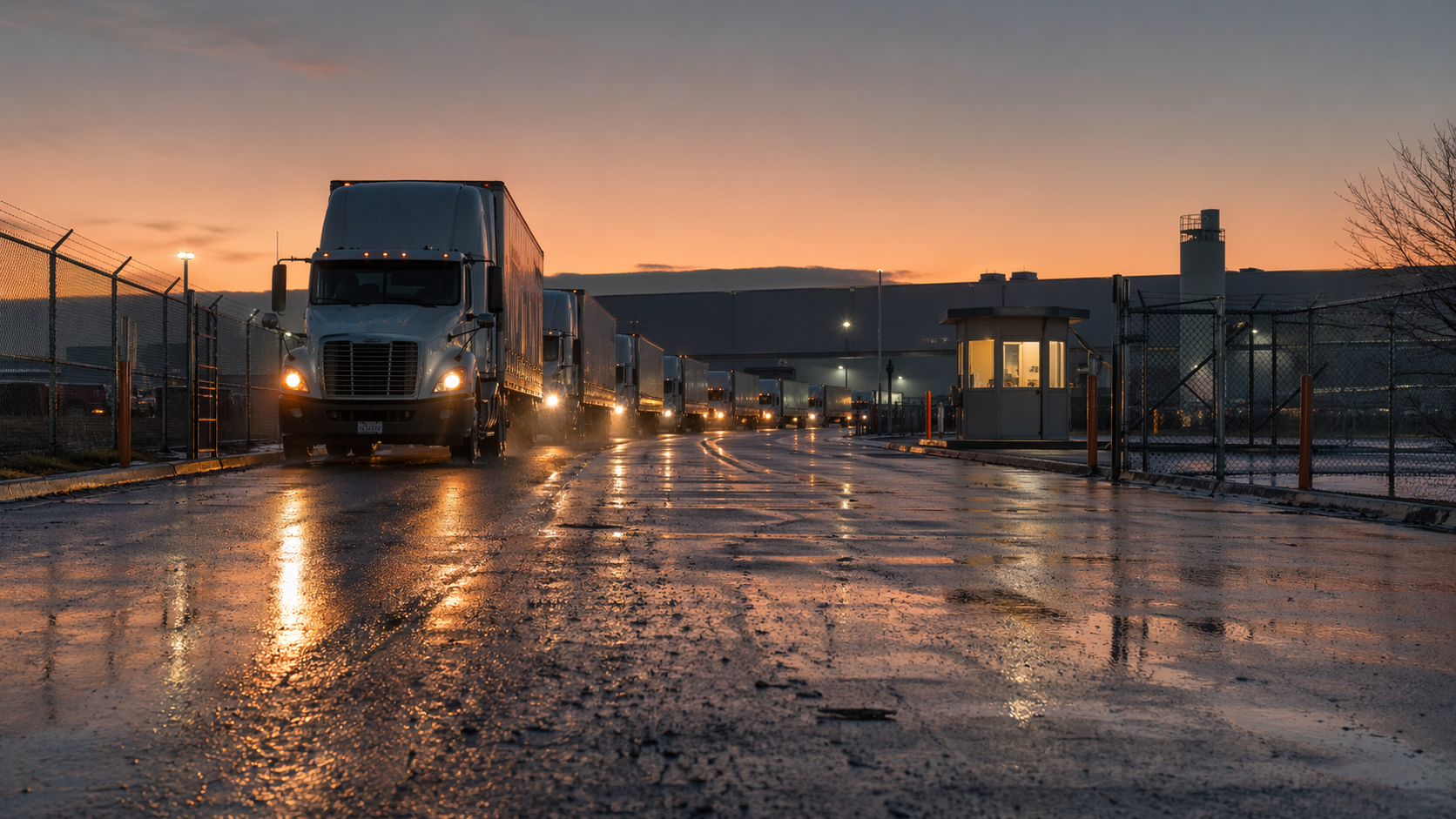
Prepare your distribution center for peak season surges: dock scheduling, yard staging, and gate check-in strategies to absorb volume spikes.
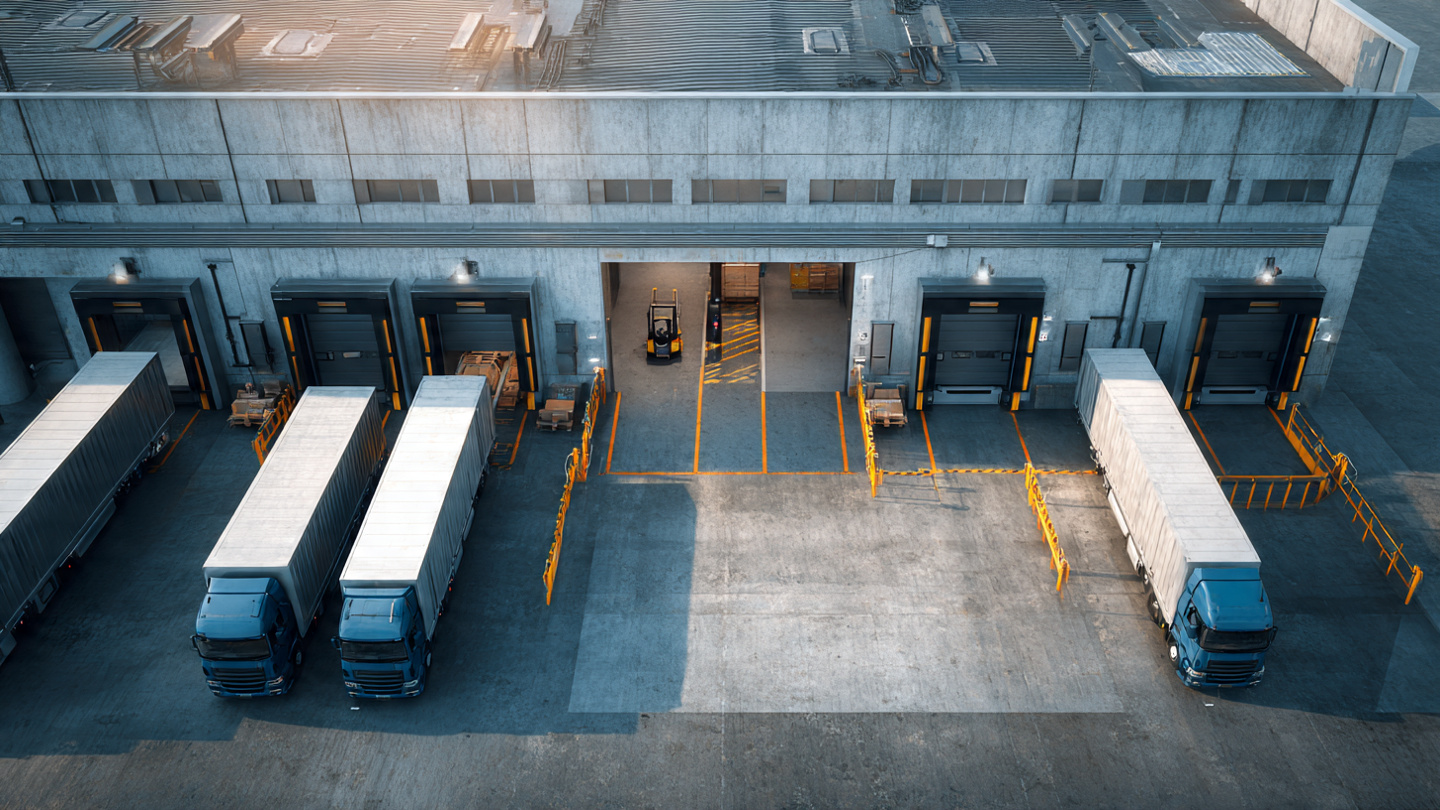
Your docks are occupied all shift but only produce at 55-65%. Learn how to measure real per-bay productivity and reclaim installed capacity.
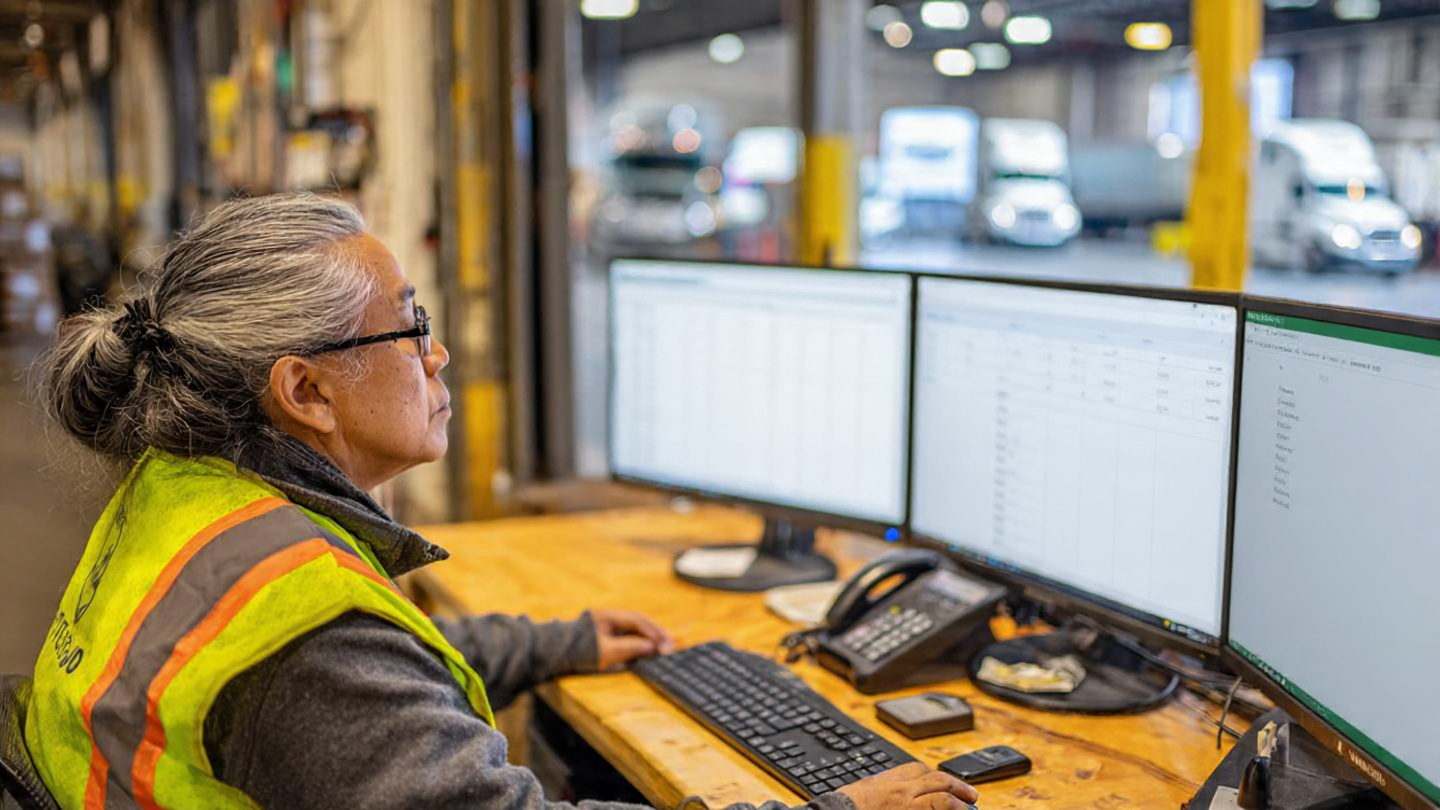
Your coordinator spends 3 hours a day on the phone with carriers. Here's how to eliminate those 50 daily calls without replacing a single carrier.