Operations
·13 min read
Warehouse Dock Labor: How Many People Is Too Many?
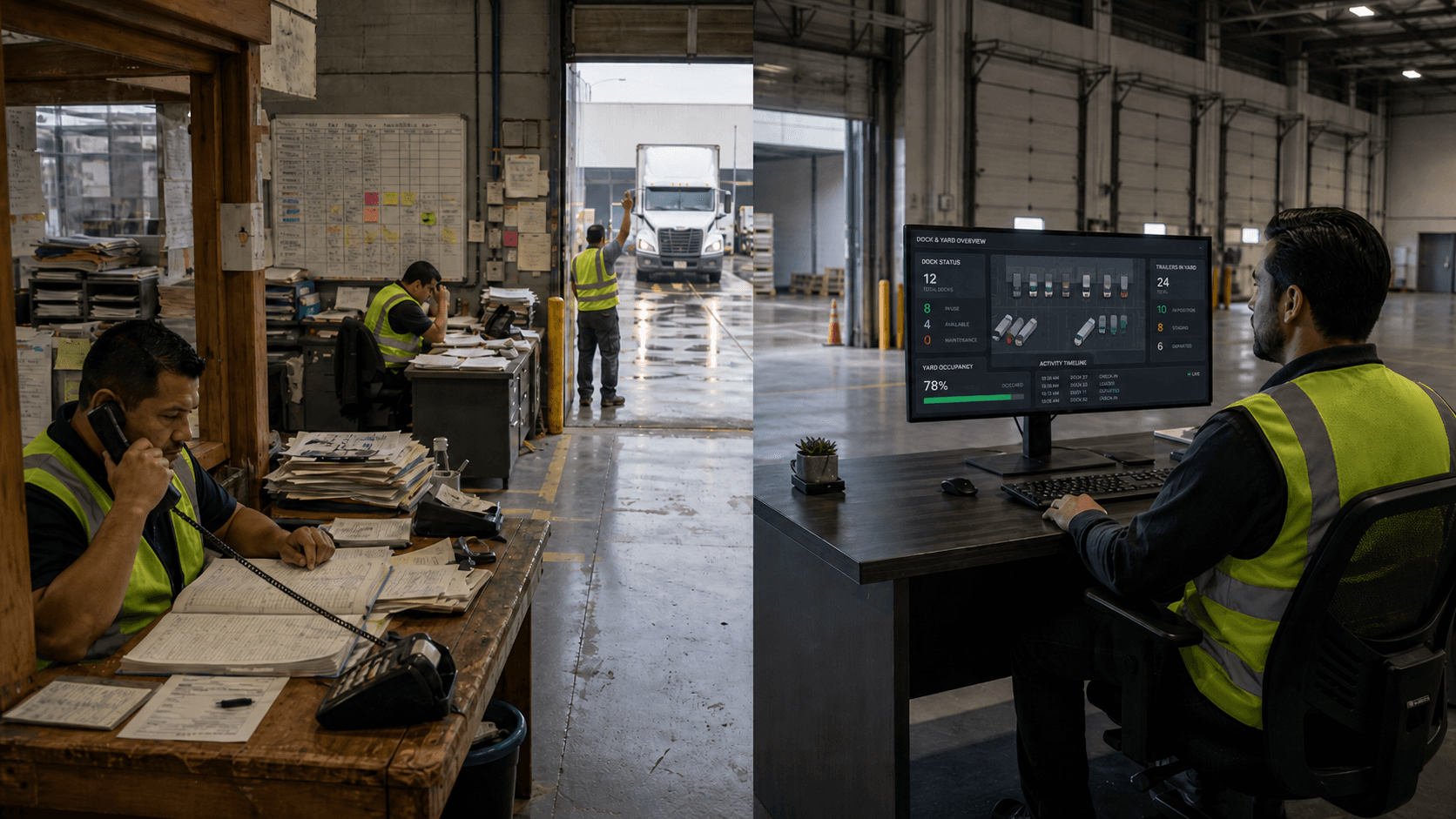
Your dock coordinator is not lazy. Your jockeys are not slow. Your gate guard is not slacking. But right now, your operation probably has five to seven people per shift whose main job is passing information from one person to the next — and almost none of that information ends up in a system.
That's the central problem in dock labor at most CEDIS and distribution centers in Mexico. The work is not the problem. The manual relay chain connecting the work is.
This article maps every role in the dock labor chain, puts numbers to what each one costs, shows where the overhead hides, and explains how digitization collapses four coordination roles into one supervisor reviewing a screen.
The five people between a truck arriving and a truck loading
In a paper-based operation receiving 40 to 60 trucks per day, these are the roles:
1. The gate guard (vigilante de caseta)
The guard's job looks simple: validate who arrives, write it down, open the gate. In practice they are doing five things at once.
Verify the driver's ID. Confirm the plates. Check the appointment against a printed list — when one exists. Write everything into the logbook. Call the coordinator to report the arrival. If the list is wrong, call again. If the coordinator does not pick up, wait. If two trucks arrive at the same time, one driver stands at the window while the guard finishes with the other.
On a 40-truck day, that guard makes 30 to 50 phone calls. The logbook has 40 handwritten entries, some illegible by afternoon. Every minute a truck waits at the gate because the guard is on a call or finishing a prior entry is a minute the clock runs against your dock capacity.
Labor cost: A gate guard in a Mexican CEDIS earns between $4,500 and $7,000 MXN per month base. With IMSS contributions and indirect costs, the fully loaded number runs $7,000 to $11,000 MXN per guard per month. A two-shift operation runs two guards. That is $14,000 to $22,000 MXN per month for the function of writing things down and making calls.
2. The dock coordinator (coordinador de citas)
The coordinator is the central node of the relay chain. Everything flows through them: arrivals from the guard, dock status from the supervisor, yard updates from the jockey, appointment changes from carriers, priority requests from the warehouse manager.
They maintain the daily schedule — usually Excel or a whiteboard — and match incoming trucks to available dock slots as the day moves. When something breaks (truck arrives late, a dock runs long, a carrier reschedules), they renegotiate everything by hand.
As our post on eliminating carrier calls at the warehouse documents, a coordinator at a 45-truck-per-day operation fields more than 50 phone interactions per shift. That is before internal calls to the supervisor, jockey, and guard. The arithmetic is brutal: more than three hours of an eight-hour shift goes to phone and radio coordination.
Labor cost: Coordinators earn $7,000 to $12,000 MXN per month base. Fully loaded: $11,000 to $19,000 MXN per month. They're the highest-cost role in the coordination chain, and the most fragile — the knowledge that makes them effective lives in their head, not in a system.
3. The yard jockey (jockey de patio)
The jockey moves trailers. They position incoming units near the assigned dock, reposition units when plans change, and pull completed trailers to free dock space. Without a jockey, trucks end up in the wrong place.
What makes jockey labor expensive is not the salary. It is the idle cycles — time waiting for instructions, repositioning units because the coordinator's mental map of the yard was 15 minutes stale, or moving a trailer that will need to move again shortly because a dock assignment changed.
In a disorganized yard, the same trailer gets repositioned two or three times a day. Each cycle takes 8 to 15 minutes. The salary cost is moderate. The dock capacity cost — the dock that could not receive the next truck while the yard got sorted out — is not.
Labor cost: $5,500 to $8,500 MXN per month base, fully loaded $8,500 to $13,500 MXN per month. Most medium operations run one to two jockeys per shift.
4. The receiving supervisor (supervisor de recibo)
The supervisor runs the dock floor. They confirm when a dock clears, manage the receiving team's priorities, handle discrepancies, and relay dock status back up to the coordinator.
On paper, they are managing the work. In practice, a good chunk of every shift goes to status calls — reporting to the coordinator what is happening at each dock — rather than managing the receiving operation itself. They are the relay point between the physical dock and the coordination layer above it.
The real problem: dock assignment decisions get made based on the supervisor's last report, not what is happening now. If they are dealing with a discrepancy at dock 3, their last word on dock 5 might be 20 minutes old. The coordinator acts on that 20-minute-old picture. Everything downstream is only as accurate as that lag.
Labor cost: $9,000 to $15,000 MXN per month base, fully loaded $14,000 to $23,500 MXN per month.
5. The data-entry clerk (capturista)
In many CEDIS, the logbook does not live only at the gate. Arrivals, departures, discrepancies, and dock assignments need to go into the WMS, ERP, or reporting system. Someone has to put them there. That someone is usually a capturista.
They transcribe what the guard wrote, what the supervisor called in, and what the coordinator tracked in their spreadsheet into whatever system of record the warehouse uses. The job is pure information transfer. The data existed at the gate; now someone is moving it to a screen, 30 to 90 minutes later, with transcription errors along the way.
The data that reaches the WMS is a reconstruction of what happened. Not a record.
Labor cost: $5,500 to $9,000 MXN per month base, fully loaded $8,500 to $14,000 MXN per month.
The full labor chain: what coordination costs per shift per month
Add it up for a two-shift operation with five coordination roles per shift:
| Role | Fully loaded (per shift/month) |
|---|---|
| Gate guard | $7,000 – $11,000 MXN |
| Dock coordinator | $11,000 – $19,000 MXN |
| Yard jockey (1.5 avg) | $12,750 – $20,250 MXN |
| Receiving supervisor | $14,000 – $23,500 MXN |
| Data-entry clerk | $8,500 – $14,000 MXN |
| Total per shift | $53,250 – $87,750 MXN |
| Two-shift operation | $106,500 – $175,500 MXN/month |
That range — $106,500 to $175,500 MXN per month — is what a mid-size Mexican distribution center spends on coordination labor. Before the receiving team that actually touches the product. Pure overhead to move trucks from gate to dock.
And it is not only the salary line. It is the fragility. When the morning coordinator leaves at 2 PM, 30 minutes disappear to a verbal handoff. When the guard calls in sick, the gate slows. When the jockey's radio dies, the yard goes quiet. The entire system depends on individuals filling gaps that no system tracks.
Is your coordination overhead in line with your dock count? The Docklyx Dwell Cost Calculator includes a labor component that shows exactly how much of your dwell cost comes from coordination overhead versus dock idle time. Run it against your own numbers.
Where the hidden labor overhead actually lives
The salaries are visible. The real overhead comes from three multipliers.
Rework from bad information
Every decision made on stale data generates rework. The jockey repositions a trailer to dock 6 — but dock 6 is not free; the coordinator's board is 15 minutes behind. The trailer goes back to staging. That is 15 to 20 minutes of jockey time, zero value delivered.
Hidden costs in gate queues compound the damage: the rework does not stay isolated. It backs up the queue. The next truck waits longer. The guard makes another call. The coordinator updates the board. Four roles touched by one bad data point.
The shift handoff tax
Shift changes are where paper-based operations bleed an hour of productivity. The incoming coordinator needs the state of every dock, every truck in the yard, every carrier in the queue. The outgoing coordinator has that picture in their head. The handoff is 20 to 40 minutes of verbal briefing — often incomplete.
On a three-shift operation, that adds up to two hours a day. Sixty hours a month, gone. A live dashboard makes the entire conversation unnecessary.
Carrier calls that should not exist
As covered in detail in how to eliminate carrier calls at your warehouse, a large share of coordinator labor is reactive: carriers calling to confirm their appointment is still valid, to find out which dock to go to, to ask if arriving 30 minutes early is okay. These calls exist because carriers have no visibility into your operation. Each one takes 3 to 7 minutes. At 15 to 20 such calls per shift, that is up to 2.3 hours of coordinator time spent answering questions a system should have handled automatically.
Case study: before and after digital gate operations at a Monterrey CEDIS
A grocery distribution center in Monterrey — 7 docks, 50 trucks per day, two shifts — ran a full labor review after the operations director noticed the coordination team had grown by two people over two years with no corresponding increase in dock output.
Before (paper gate, Excel schedule, phone relay):
- Gate guards: 2 per day (one per shift), logging arrivals by hand, making 35 to 45 calls per shift
- Dock coordinators: 2 per day, maintaining an Excel schedule and a whiteboard dock board, with roughly 3 hours per shift on phone coordination
- Jockeys: 2 per shift (4 per day), with significant idle time between assignments due to unclear yard status
- Capturistas: 2 per day, entering logbook data into the WMS 60 to 90 minutes after each event
- Receiving supervisors: 2 per day, spending 40% of their time on status calls versus dock floor management
Total coordination headcount: 12 people per day across two shifts. Fully loaded monthly cost: approximately $148,000 MXN.
Dock idle time — the window between a dock clearing and the next truck pulling in — averaged 22 minutes per dock per turnover. With 7 docks turning an average of 6 times per shift, they were losing roughly 15 hours of dock capacity per day to communication lag.
After implementing digital appointment management, QR check-in, and real-time dock status:
The transition took three weeks. Here is what changed:
- Guard role shifted from manual logging and calls to QR scan and validation. Call volume dropped from 40+ per shift to under 8.
- Coordinator's Excel and whiteboard replaced by a live appointment dashboard. Phone interactions with carriers dropped 75%. One coordinator per shift handled what previously required two.
- Jockey repositioning cycles decreased 40% because dock assignments were confirmed before trucks arrived and yard status was visible in real time.
- Capturista role eliminated. All timestamps captured automatically at gate scan and dock status change.
- Supervisor shifted from status calls to exception alerts. Time on the dock floor increased from 60% to over 85% of the shift.
Results:
- Coordination headcount: 7 people per day (down from 12)
- Monthly coordination labor cost: approximately $83,000 MXN (down from $148,000 MXN)
- Monthly savings on coordination labor alone: approximately $65,000 MXN
- Dock idle time between turns: 9 minutes (down from 22 minutes)
- Trucks processed per shift: average of 28 (up from 22)
The operation did not shrink — it grew. Three of the five displaced coordination roles moved to the receiving team. Dock capacity increased 27% without adding a dock door or hiring additional receiving staff.
The automation math: which roles collapse and which stay
Digital dock management does not eliminate all five coordination roles. It restructures them.
Roles that reduce or disappear:
The capturista goes entirely. There is nothing to transcribe when the system captures events in real time. The coordinator's call volume drops to 20 to 30% of its paper-based level — whatever remains are genuine exceptions, not information requests. The jockey's idle cycles drop because pre-assigned slots and live yard visibility mean arriving at the right spot the first time.
Roles that stay but change:
The gate guard stays. Physical validation — confirming the driver, checking the seal, controlling access — still needs a person at the gate. What changes is the logging: instead of writing in a notebook and calling the coordinator, they scan a QR code, the system logs the event, and the coordinator sees it automatically. Faster, more accurate, less cognitive load.
The receiving supervisor stays too. Managing the dock floor, resolving discrepancies, directing the receiving team — those are human jobs. The change is in the information layer: instead of calling the coordinator every 20 minutes with updates, the supervisor responds to exceptions the system flags. More time on the floor, less time on the phone.
The net change:
A 5-role, 10-to-12-person coordination operation becomes a 3-role, 6-to-7-person operation. One coordinator reviews a dashboard instead of juggling a whiteboard and a phone. The supervisor handles exceptions instead of relaying status. The guard validates QR codes instead of transcribing plates.
Five roles' worth of manual coordination compresses into one person's dashboard review.
How to tell if your operation is overstaffed for its volume
Before restructuring or cutting headcount, pin down where the coordination labor is actually going.
Run this diagnostic:
-
Count calls per shift. Ask your coordinator to log every phone interaction for one week — incoming, outbound, radio. If the total exceeds 40 per shift, you are running a phone-relay operation, not a coordinated one.
-
Time the shift handoff. Clock how long the incoming coordinator needs before they can make decisions. If it is over 10 minutes, decision-enabling information is not in a system — it is leaving with the outgoing coordinator.
-
Track jockey repositioning cycles. Have your jockeys note every time they move the same trailer more than once. If more than 20% of moves are repeat repositions, yard state information is stale at the time assignments are made.
-
Measure dock idle time between turns. The full methodology is in our guide on dock productivity per bay. The quick version: time from dock-clear to next truck-in. If that average exceeds 15 minutes, information latency is the bottleneck — not truck volume.
-
Find the capturista's time gap. Ask how long after an event it appears in your WMS or ERP. If the answer is "an hour or more," your system of record is a reconstruction, not a record.
Two of these symptoms together means your coordination labor is working hard — just around a system gap rather than through a system.
How Docklyx restructures dock labor
Here is what changes, role by role, when a CEDIS moves to Docklyx.
At the gate: Carriers arrive with a QR code from their appointment booking. The guard scans it on their phone or tablet. The system confirms the appointment, logs the timestamp to the second, and pushes the dock pre-assignment to the coordinator's screen. No call. The guard moves to the next truck. Gate arrivals that took 4 to 6 minutes drop to under 90 seconds.
The full picture of what the guard's shift looks like in a digital operation is in a day at the gate: your DC guard's real workflow.
At the coordinator screen: A live appointment board replaces the whiteboard and the spreadsheet. They see every truck — gate entry time, dock assignment, current status — without a single call. Carrier self-service cuts inbound call volume 70 to 80%. The coordinator stops managing information and starts managing exceptions.
In the yard: Jockeys get pre-confirmed dock assignments on their device before the truck arrives. Repositioning cycles drop because the first assignment was right. When something does need to change, the coordinator updates the system and the jockey sees it immediately on their screen.
At the dock: Status updates when the supervisor logs dock-in and dock-out. The coordinator does not need to call. The supervisor does not need to remember to report. The dashboard shows the live state of every dock without anyone having to tell it.
In reporting: Every event — arrival, assignment, dock-in, dock-out, departure — is timestamped and stored. KPI reports on dock dwell time, appointment adherence, and carrier reliability generate automatically. No capturista needed.
The capturista role disappears. The phone comes out of the coordinator's ear. The supervisor's radio goes quiet except for genuine floor issues. And dock productivity numbers most CEDIS have never measured become visible — often for the first time.
Docklyx gives you gate, yard, and dock intelligence from a single dashboard. Setup takes less than one shift. No hardware investment. The guard scans QR codes on the same device they already carry. The coordinator sees live dock status the moment they log in.
Start free for 21 days — no credit card required
Related reading
- A day at the gate: your DC guard's real workflow — how the guard's shift changes when paper logging is replaced with QR validation.
- How to eliminate the 50 daily carrier calls at your dock — where the coordinator's time goes and how to take it back.
- Dock productivity per bay: your DC looks full but runs at half — how to measure the real output of each dock door.
- Hidden costs of gate queues: 6 risks for your DC — the cost cascade that starts when the first truck in the queue waits too long.
Ready to eliminate queues in your operation?
Docklyx digitizes the entire yard: appointments, check-in, docks, and real-time traceability.
Request free demo →Get logistics insights
One email per week. No spam.
Related articles
Operations
Cross-Docking Warehouse Operations Guide
Cross-docking removes the storage buffer. Learn why dock scheduling precision is non-negotiable when freight bypasses racking and goes straight to the outbound truck.
13 min
Operations
Real-Time Visibility for Warehouse Operations
You can't optimize what you can't see. Learn how real-time yard visibility cuts decision latency and unlocks every other operational improvement.
12 min
Operations
How to Reduce Truck Turnaround Time at Your DC
Cut gate-to-gate truck cycle time at your distribution center. 5 concrete strategies for CEDIS operators to reduce turnaround time and boost throughput.
12 min