
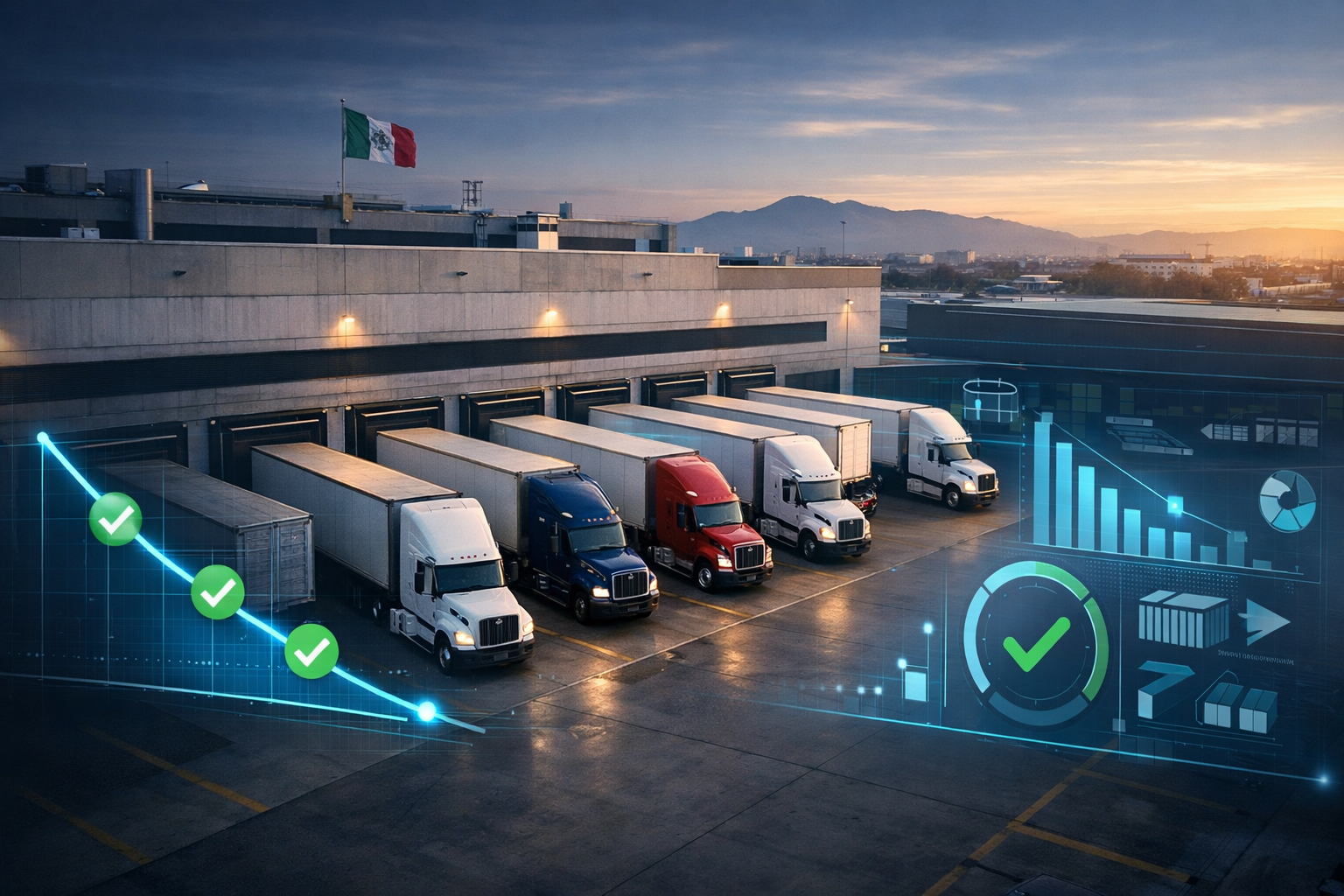
When the operations manager of a regional distribution center in Guadalajara reviewed his quarterly numbers, one figure stood out: MXN $80,000 per month in detention fees. His 18 docks handled 45 trucks per day, but the average time from gate arrival to dock connection was 2.5 hours. Carriers billed for every extra minute. The operation was bleeding money — and nobody could see exactly where.
Three months later, that figure dropped by 73%. This is the full story: what was broken, what changed, and what each improvement delivered in hard numbers.
The distribution center serves 120 points of sale across the Guadalajara metro area. Its operation is typical of the Mexican market: inbound shipments from domestic suppliers, redistribution to stores and end customers. With the nearshoring wave driving a 30% volume increase over the past year, delivery throughput grew — but the yard infrastructure stayed the same.
The result: trucks lining up from 5 AM for a shift that started at 7. Guards at the gate with paper logbooks. Drivers calling by phone to ask if a dock was free. And an operations manager who couldn't answer with certainty how many trucks were in the yard at any given moment.
Before making changes, the team documented baseline performance over 30 days:
| Metric | Value |
|---|---|
| Operating docks | 18 |
| Average trucks per day | 45 |
| Average wait time (gate → dock) | 2.5 hours |
| Trucks with excessive wait (>2 hours) | 9 out of 45 (20%) |
| Average demurrage cost per truck | MXN $1,000/hour |
| Monthly detention spend | MXN $80,000 |
| Paper-based access records | 100% |
| Manual dock assignments | 100% |
The most revealing data point: 20% of trucks — about 9 per day — waited more than 2 hours. Each of those trucks generated MXN $1,000 to $1,600 per extra hour in detention fees. Multiplied by 22 working days, the monthly cost exceeded MXN $80,000 in direct penalties alone.
That figure didn't include indirect costs: guard time spent on manual logging, phone calls coordinating with carriers (50+ per day), disputes over arrival times with no digital record, and carriers starting to prioritize other customers with shorter wait times.
According to Expansion.mx, logistics costs in Mexico can reach up to 60% of sales value — compared to an international standard of 5% to 35%. Detention fees are one of the easiest cost components to reduce with technology, and one of the most ignored by operations still running on paper.
The team had tried three solutions before looking into yard management software:
1. Spreadsheet-based appointment scheduling. A shared Excel file between the purchasing team and carriers. The problem: nobody updated it in real time. When a truck canceled, the slot stayed "blocked" in the spreadsheet but empty in the yard. There was no visibility into actual status.
2. Phone-based gate coordination. The guard fielded calls from drivers asking if they could arrive earlier. Sometimes yes, sometimes no. There was no way to know how many trucks were en route. The guard spent more time on the phone than controlling access.
3. First-come, first-served (FCFS). The logic seems fair, but it incentivizes exactly the wrong behavior: carriers arrive earlier and earlier to "claim" a spot, creating queues before dawn. A system that rewards waiting generates more waiting.
According to Deloitte, 81% of manufacturing companies in Mexico plan to increase their automation investment. But yard automation — the last analog frontier at many DCs — remains deprioritized behind WMS and TMS investments.
The team decided to implement a yard management system (YMS). The priority was clear: fast results without disrupting the operation.
System setup took less than a single work shift. The team defined 18 docks, capacity rules per hour (maximum 6 trucks in simultaneous loading/unloading), and operating schedules. That same day, 15 appointments were booked through the carrier self-service portal.
No hardware was installed. The gate guard started using his existing tablet to scan QR codes instead of writing down license plates by hand.
With 30 daily appointments flowing through the system, carriers discovered that arriving at their scheduled time meant an immediate dock assignment. Walk-ins without appointments waited longer. The incentive flipped: punctuality started winning over early arrival.
The guard reported that digital QR check-in took 30 seconds per truck, down from 3-4 minutes for manual registration.
Within one week, 100% of trucks went through the digital system. Paper logbooks stayed as backup but were never used again. The operations manager could see in real time how many trucks were in the yard, how many were at docks, and how many were waiting.
Want to see the implementation step by step? Check our guide: How to implement a YMS in less than one day.
After 90 days of operation with the system, the team measured the same metrics from the baseline assessment:
| Metric | Before | After (90 days) | Change |
|---|---|---|---|
| Wait time (gate → dock) | 2.5 hours | 35 minutes | −76% |
| Monthly detention spend | MXN $80,000 | ~MXN $21,600 | −73% |
| Paper-based access records | 100% | 10% | −90% |
| Yard dwell time | 3.2 hours | 1.8 hours | −44% |
| Manual dock assignments | 100% | 10% | −90% |
The most visible change. With scheduled appointments, trucks arrive within their time window and the dock is already assigned. The guard scans the QR, the system confirms the appointment and displays the assigned dock. No calls, no waiting, no negotiation at the gate.
The 73% reduction in demurrage translated to gross savings of MXN $58,400 per month. After deducting the software cost (MXN $14,999/month for the Pro plan covering 18 docks), the net savings were MXN $43,401 per month — over MXN $520,000 per year.
90% of records went digital. Every entry and exit is logged with exact timestamp, license plate, driver name, and dwell time. This eliminated disputes with carriers over arrival times: the system generates a digital receipt with a timestamp.
Starting in the third month, the system began using AI-powered dock assignment, distributing trucks based on operation type, cargo volume, and projected availability. This brought dwell time down by 44%, from 3.2 hours to 1.8 hours on average.
One of the most common questions before implementing a YMS is: how quickly does it pay for itself? In this case, the payback was nearly immediate.
| Item | Value |
|---|---|
| Gross monthly savings from detention reduction | MXN $58,400 |
| Monthly software cost (Pro plan) | MXN $14,999 |
| Net monthly savings | MXN $43,401 |
| Net annual savings | MXN $520,812 |
| Monthly ROI | 289% |
| Payback period | ~8 days |
The ARC Advisory Group reports that the average detention fee reduction with a YMS in the first year is 35% to 45%. The 73% result sits at the upper end, but it's explained by the starting point: a fully manual operation with high truck volume has more inefficiency to capture.
Want to calculate your own ROI? Use our savings calculator with your operation's data.
For a detailed methodology guide, see our article on how to calculate the ROI of a yard management system.
After 90 days, the team identified four key takeaways that apply to any DC considering yard digitization:
The scheduling module was the first change and delivered immediate results. When carriers have an assigned time window, they stop arriving at 5 AM to "claim" a spot. The simple act of having a scheduled slot reduced the gate queue from the first week.
The team feared resistance at the gate. The reality was the opposite: the guard was grateful to stop answering phones and filling logbooks. With QR scanning, his job simplified to scan and confirm. In less than 3 days, the process felt natural.
The first 60 days were basic operational optimization: appointments + digital check-in. From the third month onward, AI-powered dock assignment began distributing trucks predictively, anticipating peak hours and assigning docks by cargo type. This is what pushed the reduction from 65% (month 2) to 73% (month 3).
Before, a carrier could claim "I arrived at 8 AM" and the guard had no way to verify it. Now, every entry has a digital timestamp. Disputes over detention charges dropped to nearly zero because both parties can verify the records. The relationship with carriers improved.
The logistics market in Mexico is valued at over $124 billion USD, projected to reach $162 billion by 2030 according to Mordor Intelligence. The dock and yard management solutions segment is growing at 12.2% annually, per Market.us.
In this context, operations that still use paper and phone calls to coordinate their yard aren't just losing money on detention fees — they're losing competitiveness against DCs that already operate with real-time data.
According to McKinsey, operations that implement yard automation can expect:
The results in this case (73% reduction) exceed those averages because the starting point was a fully analog operation with high volume. The wider the gap between current state and optimal, the greater the return.
It depends on the carrier contract, but the typical range is MXN $500 to $1,600 per hour after free time (usually 2 hours). In operations with 20+ trucks per day and a 20% delay rate, the monthly cost easily exceeds MXN $50,000. See our full guide on what demurrage is and how it affects your operation.
No. Modern systems like Docklyx are 100% web-based. The guard uses their existing tablet or phone to scan QR codes. Carriers access the portal from any browser. No equipment installation, wiring, or dedicated terminals needed.
In this case, initial results were visible within the first week (reduced gate queues). Significant detention fee reduction consolidated between month 1 and month 2. AI optimization amplified results from month 3 onward. The investment payback period was 8 days.
The 7 key logistics yard KPIs include: gate wait time, dwell time, dock utilization, on-time rate, detention costs, check-in time, and no-show rate.
A regional distribution center in Guadalajara went from losing MXN $80,000 per month in detention fees to saving over MXN $520,000 per year. It didn't change its infrastructure, install hardware, or stop operations for a single shift. The change was process-driven: digital appointments, QR check-in, and AI-powered dock assignment.
The 73% reduction in demurrage is not a theoretical number. It's the result of measuring the same indicators before and after, over 90 days, in a real operation handling 45 trucks per day.
If your DC is still running with paper logbooks at the gate and phone-based coordination, the question isn't whether you can improve. It's how much you're losing while you don't.
Docklyx digitizes the entire yard: appointments, check-in, docks, and real-time traceability.
Request free demo →One email per week. No spam.