
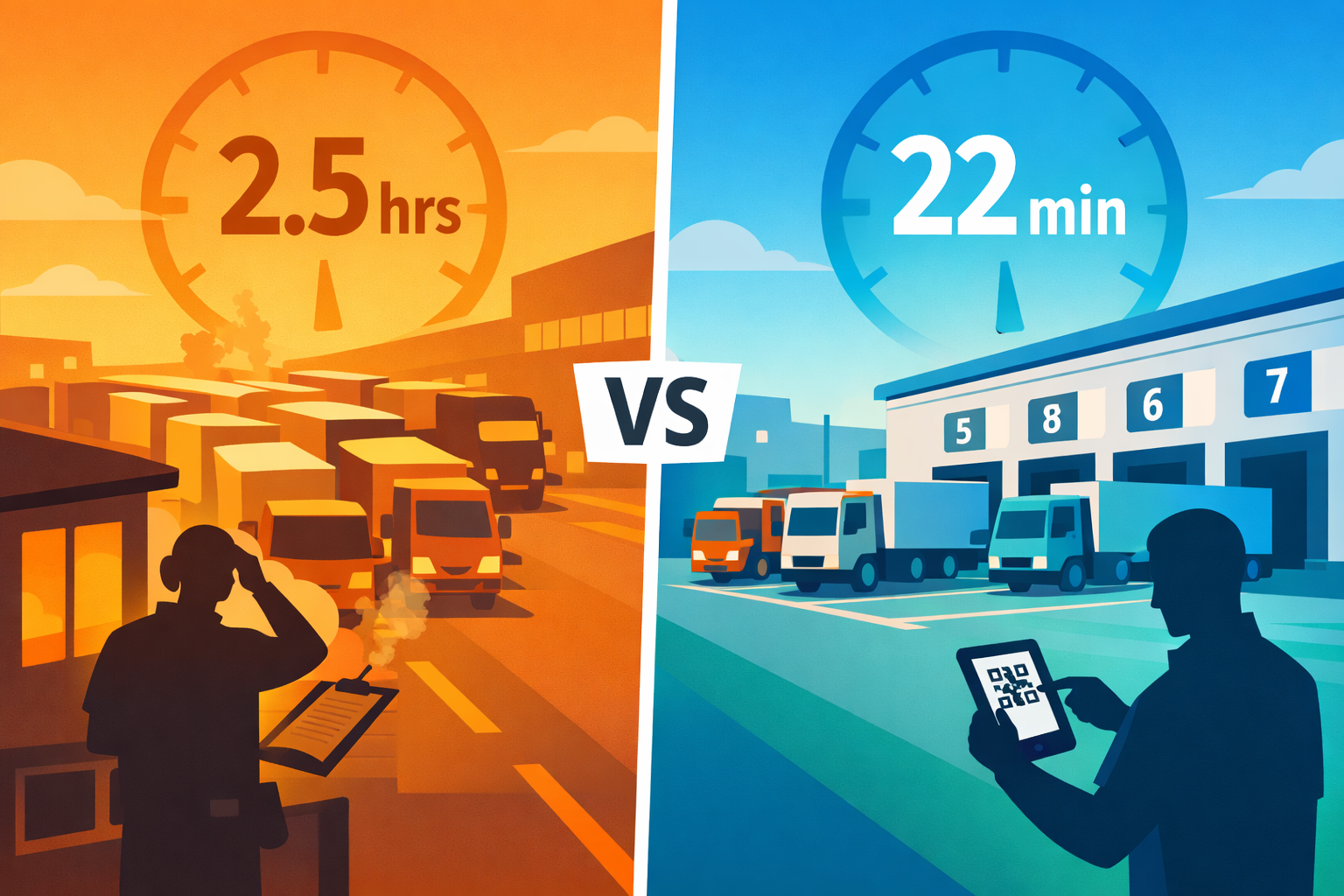
It's 5:47 AM and six trucks are already queued at the gate. The guard hasn't clocked in yet. By 7:00 when the shift starts, the line wraps around the building and drivers have been idling for over an hour. The first truck reaches a dock at 7:32. The sixth won't get in until 10:15 — if it's lucky.
This scene plays out at thousands of distribution centers every morning. It's the natural outcome of running first-come, first-served (FCFS): whoever arrives first, gets served first. Simple, fair on the surface, and for many facilities, completely unsustainable.
The alternative is dock appointment scheduling: every truck gets an assigned time window before it leaves origin. No line, no guessing, no drivers calling to ask if there's an open dock.
But the real question isn't which model is "better" in the abstract. It's which one fits your operation, at your volume, today. This article gives you the data to decide.
The principle is straightforward: trucks arrive and wait their turn. The gate guard logs them in order and waves them through when a dock opens up.
Real advantages:
Where it breaks down:
Every truck receives an assigned time window (e.g., 09:00–10:00). On arrival, the guard validates the appointment — ideally through a digital check-in — and directs the truck to its assigned dock.
Real advantages:
Where it demands attention:
| Criteria | First-Come-First-Served (FCFS) | Dock Appointment Scheduling |
|---|---|---|
| Initial setup | None | Medium (define windows, rules, communicate to carriers) |
| Average wait time | 2–4 hours at 30+ trucks/day | 15–30 minutes with good adherence |
| Dock utilization | 40–60% (unpredictable peaks and valleys) | 75–90% (distributed load) |
| Crew planning | Impossible — you don't know when volume hits | Precise — assign crews by time slot |
| Load prioritization | Manual and contentious ("why did he go first?") | Automatic by rules (perishables, urgent, premium customers) |
| Monthly detention cost | High and invisible | Reduced and measurable |
| Real-time visibility | Zero — the manager can't tell how many trucks are in the yard | Full — every truck has a status and assigned dock |
| Technology dependency | Clipboard and radio | Scheduling software, carrier portal, or messaging |
| Carrier satisfaction | Low — "I arrived at 5 and got served at 10" | High — "I know when to arrive and how long it takes" |
| Scalability | Collapses with growth | Adapts with more docks or windows |
Not every operation needs appointment scheduling. FCFS remains viable when:
If all four conditions hold, FCFS works and adding scheduling would be over-engineering.
But if even one stops being true — because volume grew, because a major customer started charging detention, because nearshoring brought 20 more trucks per week — it's time to evaluate.
There are clear signals your facility can no longer run on FCFS:
The truck-to-dock ratio is the most direct indicator. When you exceed 2.5 trucks per dock per day, queues become structural — it's not a bad day, it's the new normal.
If you receive detention invoices but can't say exactly which truck waited how long, you're paying blind. A scheduling system with gate-arrival and dock-connection timestamps gives you the data to negotiate. The cost of not having it is higher than you think.
Major retailers already require appointments. Walmart Mexico publishes specific manuals for suppliers to schedule windows at their perishables DCs. If you aspire to sell to these chains, you need a compatible process.
When the guard makes dock assignment decisions in real time — based on experience, radio calls, and memory — the system depends on a single person. If that person calls in sick or rotates to a different shift, operations degrade. Scheduling eliminates this dependency because assignment comes predefined.
Mexico is receiving a wave of logistics operations driven by nearshoring. A DC that handled 30 trucks per day 18 months ago now receives 50 or 60. FCFS doesn't scale — every additional truck adds wait time to all the others.
Figures vary by operation, but the ranges are consistent across the industry:
| Metric | Before (FCFS) | After (scheduling) | Source |
|---|---|---|---|
| Average wait time | 2.5 hours | 20–30 minutes | Loadsmart |
| Dock utilization | 45–55% | 78–90% | GoRamp |
| Truck turnaround | 3–5 hours | 1.5–2 hours | C3 Solutions |
| Detention costs | $800–$4,500 USD/month | 50–73% reduction | Real Docklyx case |
| Crew overtime | Frequent (unpredictable peaks) | Minimal (leveled load) | Opendock |
A distribution center in Guadalajara with 18 docks that implemented scheduling cut its detention fees by 73% in three months. Average gate-to-dock time dropped from 2.5 hours to 38 minutes.
Want to see these numbers at your facility? See how Docklyx automates dock scheduling in minutes, not months.
Most operations can't (and shouldn't) flip from FCFS to 100% appointments overnight. The safest path is a hybrid model:
This is the step nobody covers and where most implementations fail. It's not a technology problem — it's a change management problem:
Communicate the benefit for the driver, not just your facility. "With an appointment, you know exactly when you arrive and how long it takes. Without one, you could wait 3 hours." Drivers lose money when they wait, so they have incentive.
Offer a convenient channel. Not every carrier will log into a web portal. A WhatsApp chatbot that lets them check and confirm appointments dramatically lowers the adoption barrier.
Penalize softly at first. In Phase 1, walk-ins wait longer but aren't turned away. In Phase 3, no appointment means no service — but by then, most carriers have already adopted.
Measure and share results. Publish the average service time with appointment vs. without. When carriers see that an appointment means 25 minutes vs. 2 hours, adoption accelerates on its own.
You don't need a multi-million dollar ERP or a 6-month project. A functional scheduling system requires:
If you assign 30-minute windows for an unload that takes 45, you'll have cascading delays from the first hour. Measure your real unload time before defining windows.
A dock needs at least 15 minutes of cleanup between trucks. If you schedule back-to-back, a single delay contaminates the entire shift.
Expecting 100% adherence in the first week is unrealistic. Plan for 60% adherence in the first month and work toward 85%+ by month three.
The guard needs to see the appointment list on their device and have authority to handle exceptions within predefined rules. If they have to call the coordinator for every deviation, you've created a new bottleneck.
If you don't capture arrival time, dock assignment time, and departure time from the first day, you won't have data to adjust windows or prove ROI.
A typical shift at a DC running appointments looks like this:
6:00 AM — The coordinator reviews the dashboard: 38 appointments scheduled for today, spread across 3 shifts. They know exactly how many crews are needed.
7:00 AM — The first 6 trucks arrive. All have appointments between 7:00 and 8:00. The guard scans a QR code, validates identity, and assigns a dock in under 2 minutes per truck.
7:45 AM — A truck without an appointment shows up. The guard logs it as a walk-in and informs the driver that the first available FCFS slot is at 12:00. The driver decides to wait or reschedule for tomorrow.
10:30 AM — A truck with a 10:00 appointment hasn't arrived. The system automatically releases the dock and notifies the coordinator. The slot is reassigned to a walk-in from the queue.
3:00 PM — End of the main shift. 35 of 38 appointments were kept (92% adherence). 3 walk-ins were served during FCFS windows. Average gate-to-dock time: 22 minutes. The report generates automatically.
Compare that to the opening scene: 6 trucks at 5:47 AM with no idea when they'll get in.
This isn't about appointments being "better" than first-come-first-served. It's about your operation having a volume, a complexity, and a cost structure that determines which model works.
If your DC handles fewer than 15 trucks per day, with no load mix and no detention pressure, FCFS works and there's no reason to complicate it.
If your DC handles more than 25 trucks per day, runs multiple load types, and pays detention — or will soon due to volume growth — scheduling isn't a luxury. It's the difference between a measurable operation and one bleeding money without knowing it.
And if you're in between — 15 to 25 trucks, uncertain growth — the hybrid model lets you test with minimal risk.
The technology to implement scheduling no longer takes months or millions. A modern YMS lets you launch in days, not quarters.
What it does require is a decision: keep operating blind, or start measuring.
Is your DC still running on first-come-first-served and seeing signs it's no longer enough? Book a demo to see how dock appointment scheduling works with Docklyx.
Docklyx digitizes the entire yard: appointments, check-in, docks, and real-time traceability.
Request free demo →One email per week. No spam.
Nearshoring is flooding Mexican docks with volume. Learn how to prepare your distribution center for the new operational reality.
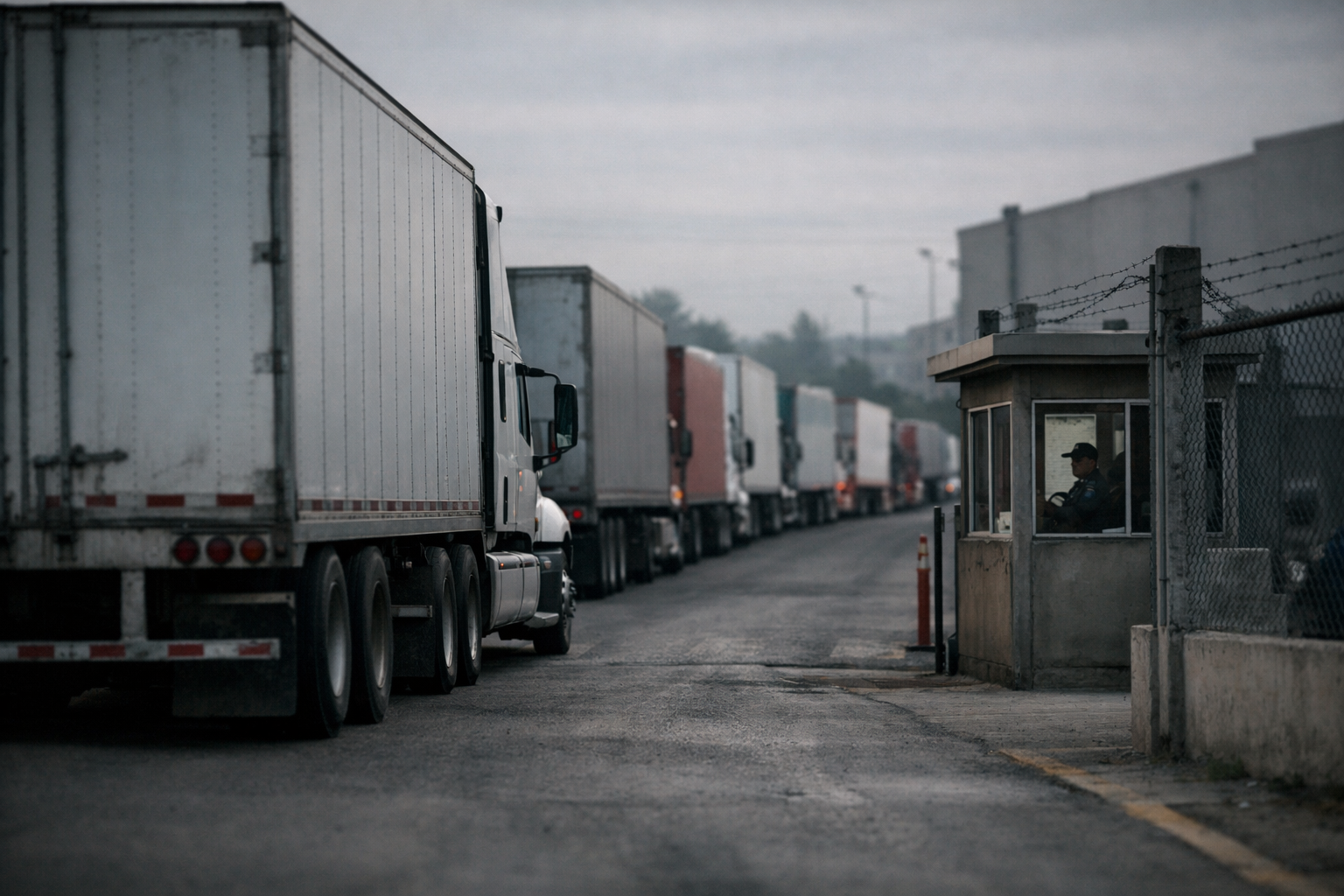
Discover the hidden costs of gate queues in 2026. From demurrage to driver churn, learn how to optimize your DC and eliminate the wait with Docklyx.
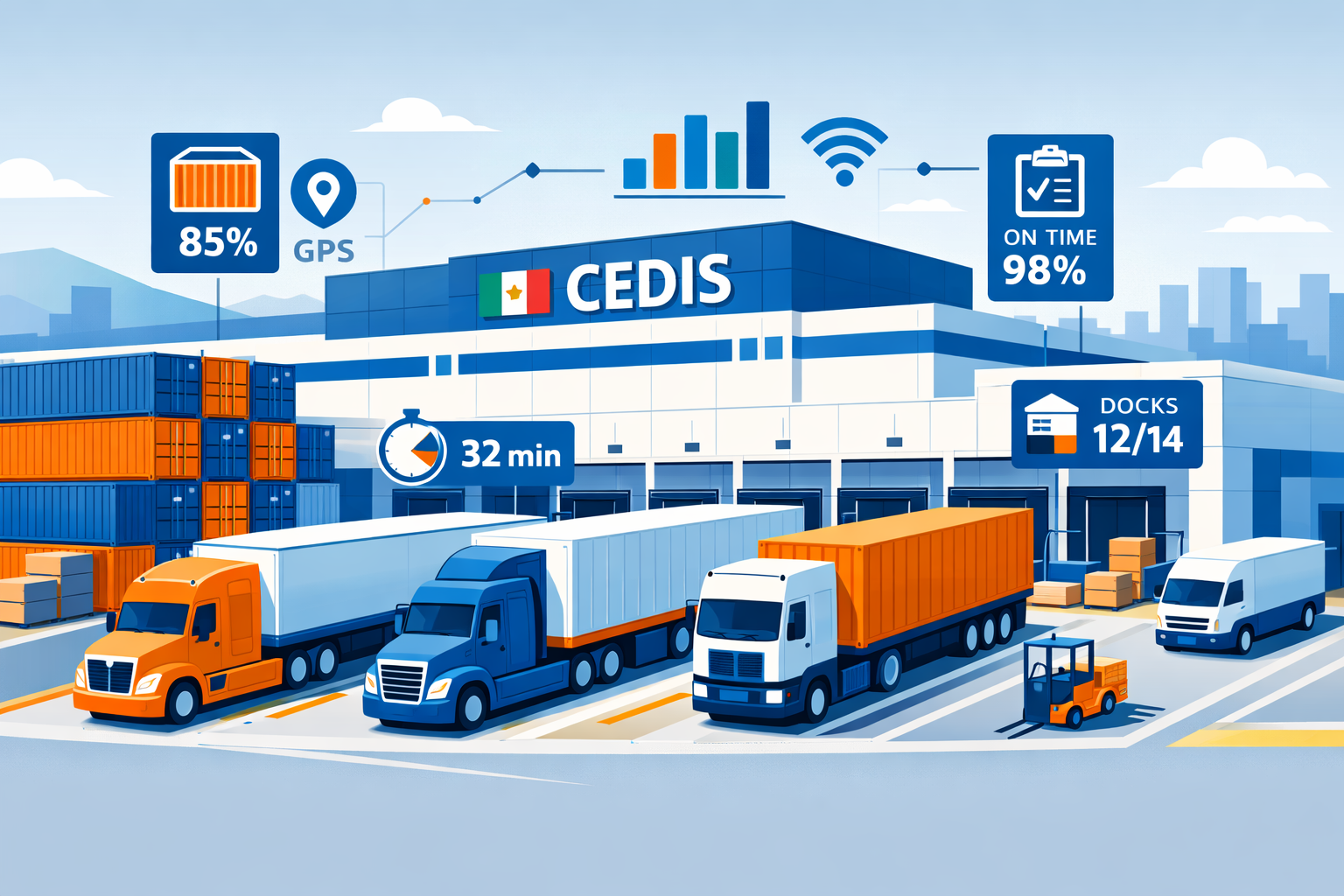
Cut wait times and demurrage fines in your Mexico DC. 2026 yard and dock guide with YMS technology. Schedule a Docklyx demo today.