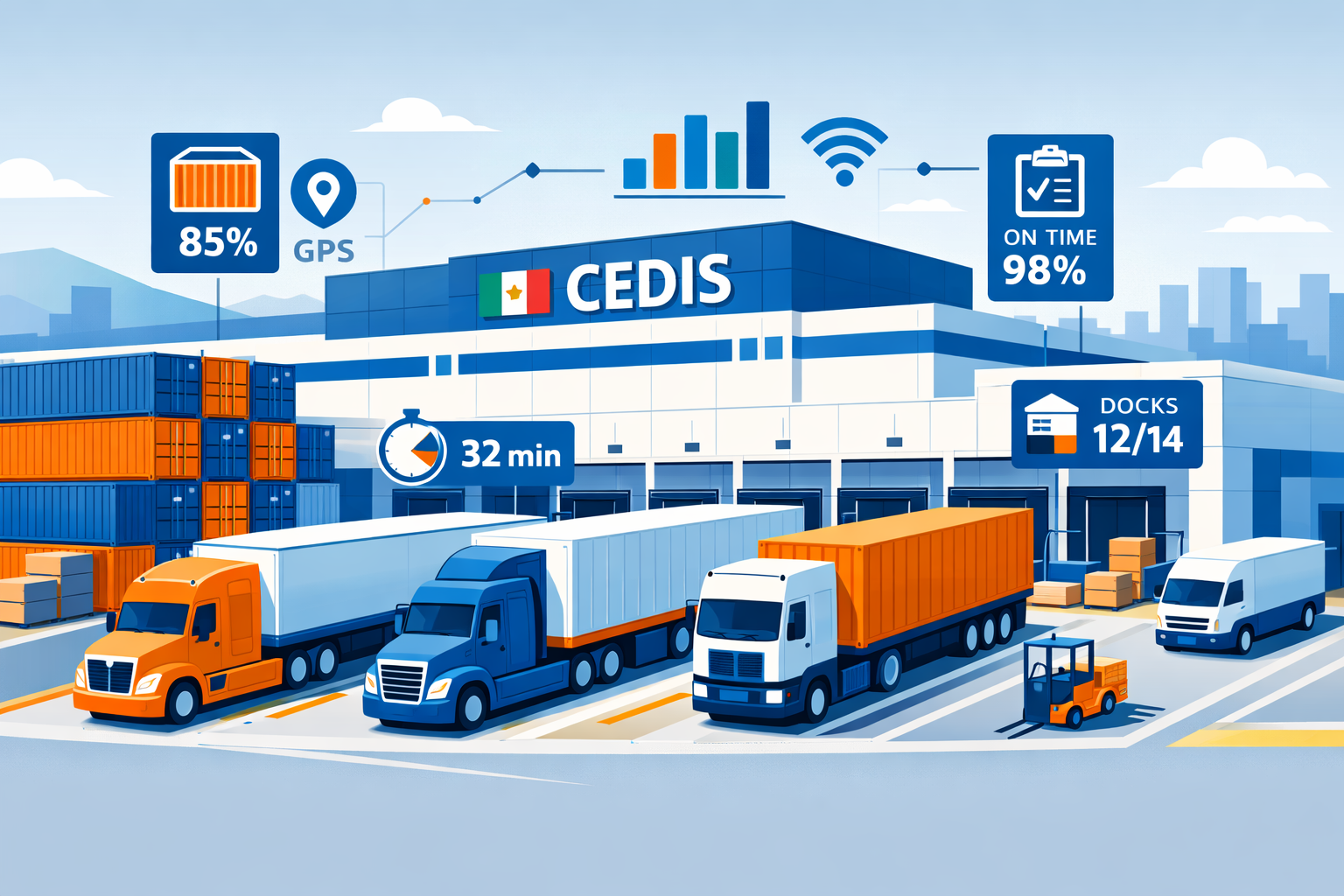
In Mexico's 2026 logistics market, the efficiency of a Distribution Center (DC) is no longer measured by what happens inside the four walls of the warehouse. With the rise of nearshoring and the saturation of major industrial corridors, the real bottleneck has moved outside: to the yard and the loading docks.
According to recent data from Gartner (2025), companies that have not digitized their yard management experience a 40% increase in indirect operating costs, mainly due to excessive wait times and demurrage fines. In Mexico, where the hourly cost of a stationary truck ranges between $45 USD and $115 USD per CANACAR (2025), yard inefficiency is a capital leak no competitive operation can sustain for long.
This guide lays out the critical strategies to transform your yard and docks into a competitive advantage, cut costs meaningfully, and improve carrier relations in the age of digital logistics.
Mexico has cemented its position as the United States' primary trading partner, attracting massive investments in manufacturing and distribution. But this boom brings an unprecedented logistical challenge. Industrial parks in Monterrey, Ciudad Juárez, and the Bajío region are running at capacities close to 98% (AMPIP, 2025), which means physical space is no longer an option. What you have is what you get.
When a DC's yard is not optimized, excess trucks don't just generate internal costs. They block the flow of the entire industrial zone. In 2026, the ability to process units quickly has become the factor that decides who wins contracts with global clients who demand surgical punctuality. If your DC is already feeling the squeeze, we recommend reading how nearshoring is impacting Mexican DCs to get a sense of what's coming.
To scale the problem, picture a standard operation in the Querétaro or State of Mexico logistics corridor. If your DC manages 60 trucks daily and each one experiences an average delay of 90 minutes due to lack of visibility or manual processes, you are wasting 90 hours of productivity per day. Not per month. Per day.
Multiplied by 25 operating days per month, the total impact easily exceeds $175,000 USD monthly. And that calculation doesn't even include penalties for missed retail delivery windows (OTIF) or reputational damage with leading carriers. To understand the leaks that never show up in formal reports, read the hidden costs of the gate queue.
After hundreds of operational audits, these are the patterns that most drag productivity down:
The foundation of an optimized yard is demand control. Moving from a "first-come, first-served" model to appointment-based management is the highest-ROI change you will make this year. If you're still on the fence, compare scheduled appointments vs first-come-first-served to see exactly when each model stops working.
A modern appointment portal lets carriers book time windows on their own. No phone calls, no emails. That alone cuts morning saturation and gives the warehouse team time to prepare staff and loading equipment in advance.
One useful number: according to McKinsey & Company (2025), implementing digital appointment systems at logistics nodes can reduce dwell times by 35% within the first 12 months.
To dive deeper into this concept, read our guide on what a Yard Management System (YMS) is or our step-by-step dock appointment scheduling guide.
The security gate is your operation's first impression, and often its first major hurdle. A manual registration process, where the guard steps down, writes in a notebook, checks ID, and then talks over the radio, takes an average of 12 to 15 minutes per truck. With 60 trucks a day, that's 12 hours of staff time spent exclusively on data capture.
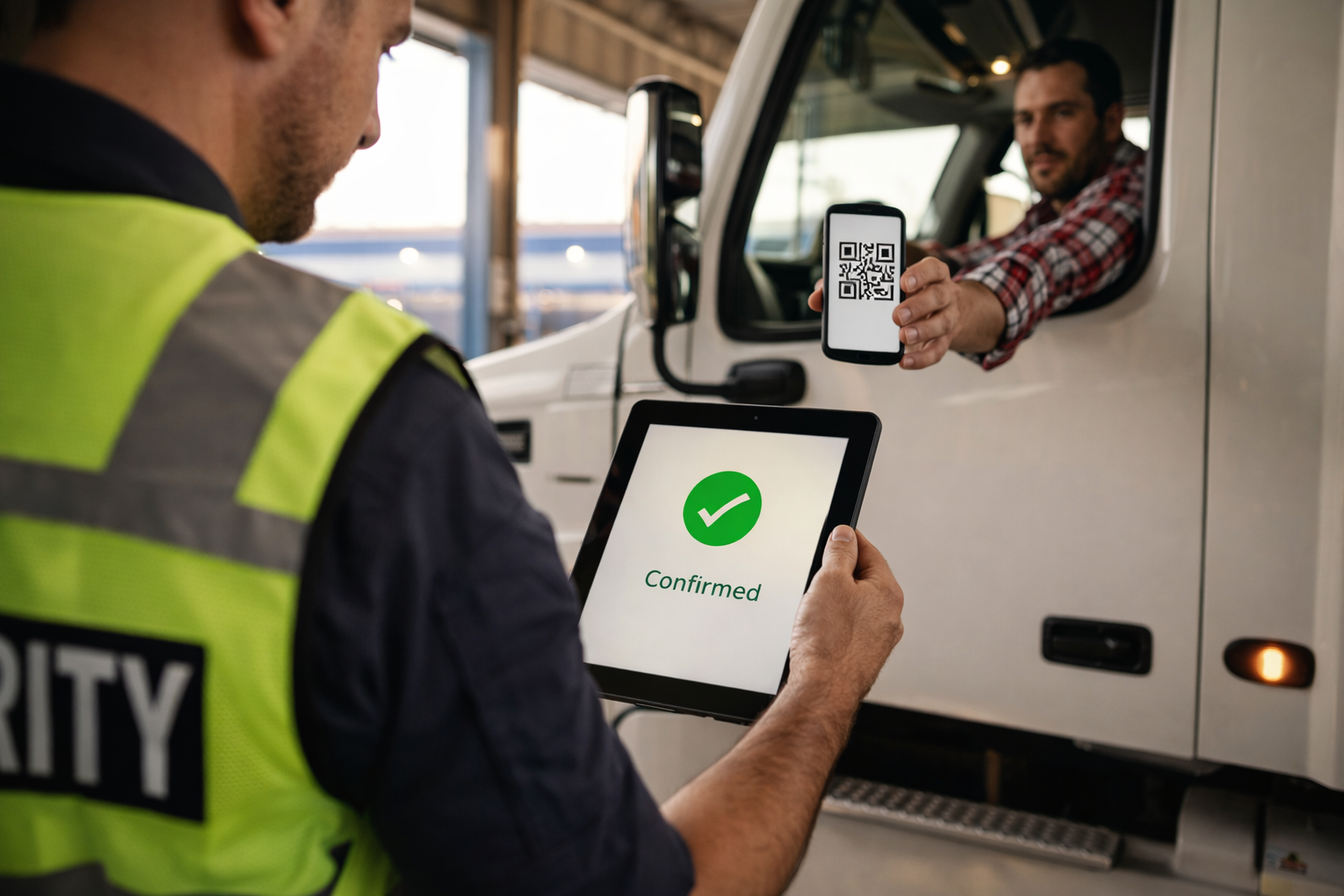
At Docklyx we've perfected digital check-in to reduce that time to under 90 seconds. The driver scans a QR code from their cab, the system validates the appointment, checks that the unit is not on a block list, and automatically assigns a dock or a staging position.
Docks are a DC's scarcest and most valuable resource. Optimizing them requires intelligent assignment based on dynamic business rules, not on the judgment of whoever happens to be on shift. For a deeper dive, read our complete guide to dock management in DCs.
An advanced YMS like Docklyx assigns the optimal dock considering inventory location inside the warehouse. If the product to be loaded sits in aisle 50, the system won't assign dock 1. It assigns dock 48. That reduces forklift travel, cuts fuel consumption, and gives time back to the operator.
In a market with driver shortages, becoming a "preferred loading site" matters more than you think. Carriers now use data to rate DCs. If your operation is slow, they raise their rates to compensate for downtime. And over time, they simply stop bidding on your lanes.
By sharing this data transparently you can negotiate better rates with the most efficient carriers and build improvement plans with the laggards. Learn more about how to score your carriers with AI and about how to negotiate demurrage with carriers using the data you already have.
Modern yard management relies on dashboards that let you intervene before things break. It's no longer about knowing what happened yesterday. It's about knowing what's about to go wrong in the next 15 minutes. For a deeper view on what to measure, read our guide on the main logistics yard KPIs.
Company: leading consumer goods distributor in Central Mexico (anonymous per NDA).
Challenge: the company faced monthly demurrage costs exceeding $25,000 USD. Carriers were starting to reject routes to this DC because wait times exceeded 8 hours during peak season. Corporate clients were threatening to move volume to a competitor.
Solution: they implemented Docklyx to manage their 45 docks. They completely eliminated paper logs and rolled out a mandatory appointment portal. They also integrated WhatsApp alerts to notify drivers the moment their dock was ready, killing the dead time spent looking around.
Results at 6 months:
If you want to dig into the methodology, check the full case study on demurrage reduction.
Not every DC captures the same return when digitalizing their yard. Size, client mix, and starting point all matter. Based on our implementations, these are the typical payback ranges:
The biggest savings come from guard time and the elimination of data capture errors. Typical payback is between 3 and 5 months. One thing that often surprises operators: a small DC serving one demanding anchor client can recover the investment by avoiding a single contractual penalty per year.
Here the biggest savings come from demurrage reduction and from capturing additional capacity without investing in infrastructure. Implementations typically pay back in 2 to 3 months. This is the most common profile among clients feeling the pressure from nearshoring.
Large DCs capture the fastest ROI, often in under 60 days, because every percentage point of improvement multiplies over huge volume. The biggest value here is not the operational savings. It's the ability to meet strict SLAs with multinational clients and win high-margin contracts that previously weren't on the table.
If you want to run the numbers for your specific case, read our guide on how to calculate the ROI of a yard management system.
To understand why Docklyx has become the standard in Mexico, let's see how users interact with the platform:
The carrier enters a clean, modern interface. They can see your DC's availability calendar in real time. When selecting a slot, the system requests unit data. If the carrier has an API integration with us, those fields auto-fill.
Your supervisors get a "Control Tower" view. On a single interactive map they see the physical layout of the yard. Trucks appear as color-coded blocks:
Need to move a truck from dock 5 to dock 12? Just drag it across the screen. The system automatically sends an instruction to the driver via WhatsApp: "Unit 402, please move to Dock 12 to finalize your unloading." No shouting, no confusion.
Every movement is recorded with millisecond precision. If a carrier claims an unjustified demurrage fee, you can export a report with check-in photos, dock times, and a digital exit signature. The data is immutable and holds up as legal proof in billing disputes.
It depends on the size of the operation and the starting point, but a typical Docklyx implementation runs 1 to 5 days. A DC with 10-15 docks can be operating with digital appointments the next day. One with 40+ docks and multiple clients usually needs 3 to 5 days of configuration. The long 6-to-12-month implementations belong to legacy systems, not to modern yard-focused platforms.
No. A YMS and a WMS solve different problems. The WMS manages inventory inside the warehouse. The YMS manages what happens in the yard, at the docks, and at the gate. The two systems coexist and ideally integrate via API. For a full comparison, read our guide on YMS vs WMS vs TMS.
Even if your DC doesn't pay demurrage directly, the hidden costs are still there. Carriers pass them through via higher rates, lane rejections, or dead-time charges. On top of that, missing a retail delivery window can cost several times more than a year of demurrage combined. A YMS pays for itself through contract retention, not only through direct savings.
It's the most common concern, and the reality is that carriers adopt the tool quickly once they see it saves them time. In real implementations, 80% of carriers are using the appointment portal within the first two weeks. The remaining 20% come along when they see everyone else getting to the dock before them. Nobody wants to be last in the queue.
Yes. Most customers begin with the appointment portal and digital check-in, then activate additional modules (intelligent dock assignment, alerts, automated reports, carrier scoring) in the following weeks. This lets you phase the operational change without overwhelming the team.
Optimizing your Mexico DC's yard and docks is no longer a side project. It's a direct financial decision. Every dollar saved in demurrage fines and every minute gained at the security gate goes straight to your company's bottom line.
In an environment marked by accelerating nearshoring and growing supply chain complexity, digitalizing the yard is the only realistic path to operational resilience. The DCs that decide to move in 2026 will capture the highest-margin contracts of the decade. The ones that wait will watch them go to someone else.
Is your operation ready to take the next step?
Discover the power of Docklyx. Schedule a demo with our specialists here.
Docklyx digitizes the entire yard: appointments, check-in, docks, and real-time traceability.
Request free demo →One email per week. No spam.
Nearshoring is flooding Mexican docks with volume. Learn how to prepare your distribution center for the new operational reality.
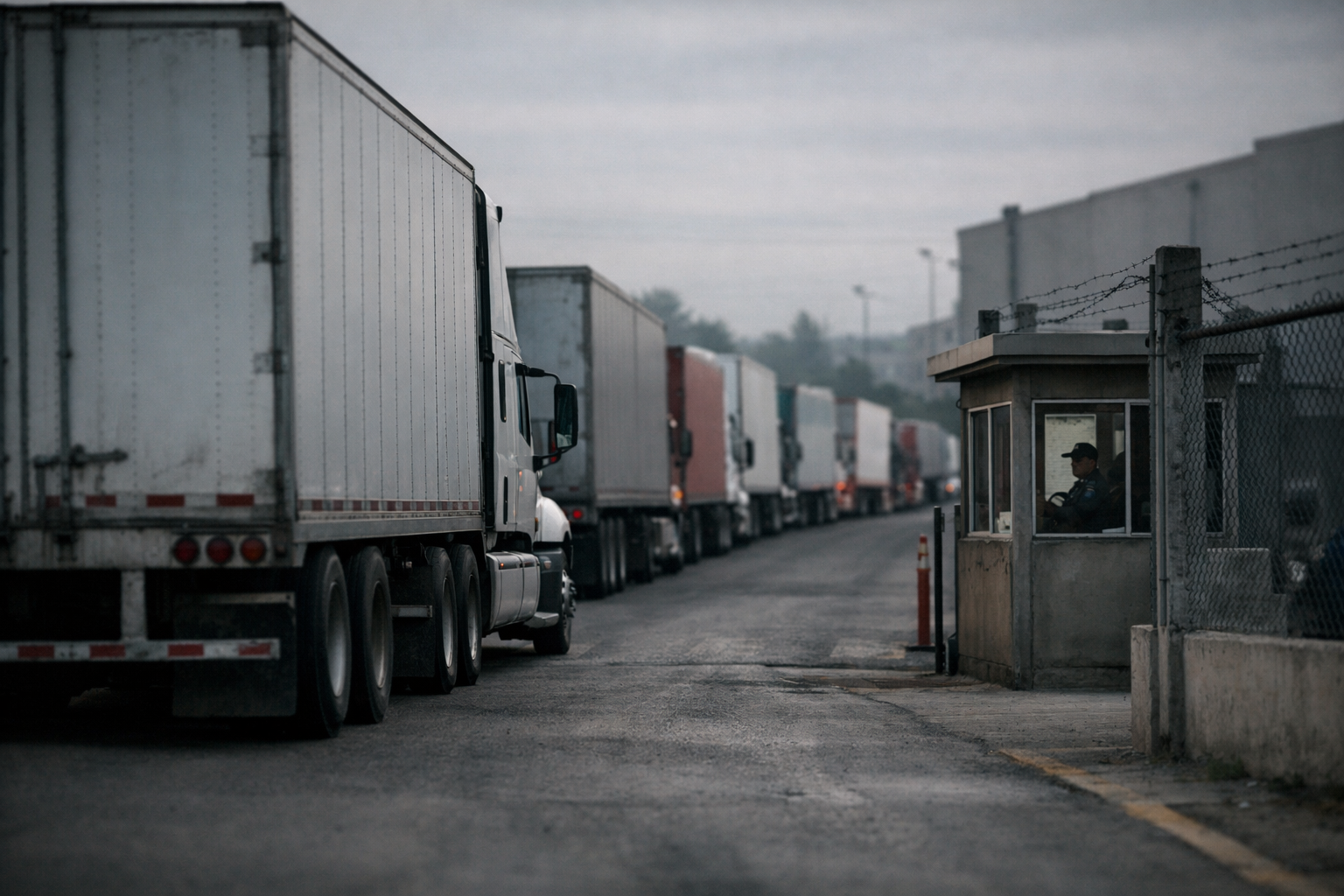
Discover the hidden costs of gate queues in 2026. From demurrage to driver churn, learn how to optimize your DC and eliminate the wait with Docklyx.
Learn how to implement a yard management system in under 24 hours without operational downtime. Step-by-step guide with real 2026 data.